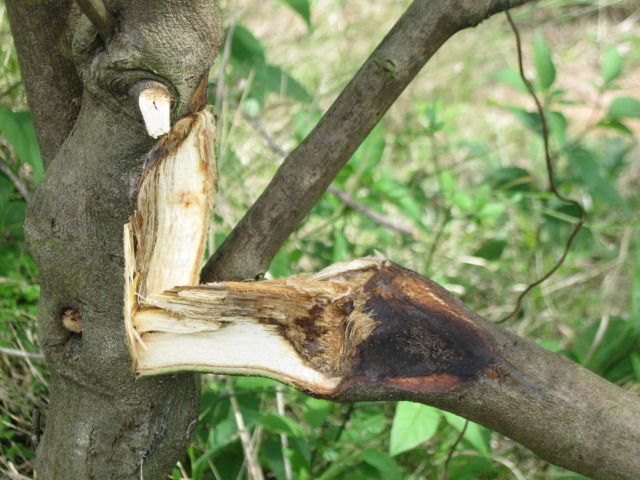
 The most common fractures are bifurcations, in which the branches form a small angle with each other. This damage is much more common in older trees, because in such places there are certain stresses caused by the increase in thickness of the forked branches at the point of contact of their surfaces. These stresses can lead to hidden fission, which becomes a wound. The location of such a wound allows a constant inflow of rainwater. The wound cannot heal, because it is a fissure opening further and further. The healing tissue that is formed undergoes constant mechanical irritation due to the movements of the branches during the wind. Therefore, in such forks, the wood decomposes very quickly, a significant loss of which eventually causes one of the branches to break off. Such a split is sometimes very long and may involve a significant part of the lower trunk. The remaining limb is also very often broken at the bifurcation.
The bifurcation wounds are very complicated, difficult to protect and heal, and they disfigure trees greatly. The care and treatment of such wounds on poorly generally poor trees may not be justified and sometimes it is best to remove such damaged trees.
Prevention of the above-mentioned damage consists mainly in the proper shaping of the crown structure and preventing a narrow bifurcation of two equal branches.. Cracking can often be prevented by the use of appropriate bonds. These bonds work by forcing two or more branches to hold on to each other, and prevents them from breaking or breaking off at the bifurcation.