Planting of ornamental plants
We plant ornamental plants, including trees and shrubs, bushes, herbs, bulbs and annuals. Depending on the needs, we can plant various types – we plant hedges, we create varied compositions of plants in private gardens, we introduce vegetation next to communication routes, we strengthen the slopes with vegetation, we plant plantings at companies, schools, restaurants, churches. Planting material, which we use comes from renowned nurseries from Podkarpacie and Lesser Poland and is adapted to the climate in the vicinity of Rzeszów, so you can be sure, that the plants will grow healthily and look beautiful. Our employees have the appropriate knowledge and skills, which guarantees professional execution of the order.
In addition to planting, we also perform works such as mulching planted plants with various materials (agrotextile + pine bark, stone grit, wood chips) and we make edging of wood plantings, plastic, stone and paving stones. This way of developing the space in the garden significantly reduces the amount of work in the garden, e.g.. when weeping and weeding plants and improves their growth conditions.
To learn more about the selection of plants for planting and the method of planting, we suggest, for you to get acquainted, with the rest of the text.
Plant selection – how to avoid mistakes?
Before making plantings, it is necessary to think carefully in what place, how many and what plants we will plant. Mistakes made at the beginning, will be difficult to correct, once the plants have started to grow. If you intend to make larger plantings, it is worth drawing up a project.
When selecting plants, first of all, take into account their target size – small at the beginning, the shrub may grow beyond measure with time and take up half of the backyard garden. In turn, dwarf conifers planted as a hedge, they will grow too slowly and it will be several years before they begin to fulfill their function. When choosing plants, you should carefully choose them in terms of size and planting spacing, so that they fulfill their functions and do not pose a problem in a few years. If you do not have experience in this regard, it is best to rely on the experience of the gardener, or a greenery designer
Another very important factor influencing the choice of plants are climatic and soil conditions. In the conditions of Rzeszów and its vicinity, gardens should not be chosen from species that are not fully frost-resistant and susceptible to drought.. The species and varieties should be abandoned, which are growing in Poland, but in regions with milder and wetter climates, e.g.. by the sea. When planting in Rzeszów, e.g.. laurel hedge we have to take this into account, that it will freeze every winter, and if there are frosts greater than -25 oC can freeze up completely. When selecting plants, apart from climatic conditions, soil conditions must also be taken into account. You should not choose e.g.. in sandy and dry places of plants with high requirements as to soil moisture, e.g.. palm maples and garden hydrangeas – a better option is to choose junipers, soy and brisket, which in such conditions cope perfectly. On the other hand, for periodic flooded soils, it is best to choose e.g.. metasekwoje, willows and miscanthus. The fertility of the soil is also an important factor, but on this point, a lot can be changed, even by loving fertilization.
When choosing a planting site, you must take this into account, that plants form a garden composition and should be properly combined in size and color, so that the whole thing looks harmonious. Moreover, not all plants can grow in the same place. In even a small garden, the habitat conditions of the fashion can be very different in different parts of it. Sheltered and shaded places should be planted with other species, than exposed and sunny. Shadow range, windbreak, soil moisture, the presence of old trees are factors, which have a very strong influence on what plants can be selected for a specific place.
How and when to plant?
The choice of the method of planting depends largely on the type of plant material. Plants produced in pots can be planted throughout the growing season, dug from the ground together with the lump in March-April and September-October, in turn, they are dug from the ground with bare root in early spring, or from mid-autumn to the end of October. If possible, avoid planting in periods of drought and very hot weather. However, if there is no choice, it is imperative to keep the soil moist.
When planting plants, you should dig holes approx. 2 times greater than the volume of their root balls. The soil inside the hole is loosened and treated with fertile soil, or peat substrate, worth mixing with compost, or multi-component fertilizer (from mid-July, however, nitrogen fertilization should not be applied), Put the root ball of the plant into the well prepared in this way and cover it with fertile soil, or soil selected from the well mixed with a peat substrate. Knead the soil around the roots. The type of soil we use to dress the holes depends on what plants we plant, e.g.. for rhododendrons it should be acidic and humus soil. Plants are generally planted to the same depth as they grew in the nursery, however, there are exceptions to this rule (np. spoilers). After planting, the plants should be watered.
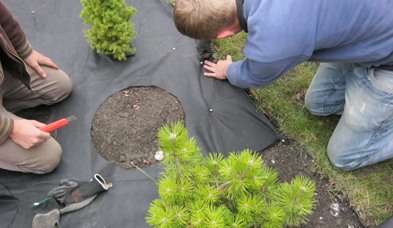
It is very good practice to mulch the plantings. This is of great practical importance, especially in the case of plant compositions, in which plants grow close together, because it reduces the number of weeds appearing between plants and also protects plant roots from drying out by increasing soil moisture under the mulch layer. An agrotextile can be used for mulching, which is pinned to the ground with pins, or nails. The agrotextile is covered with pine bark, stone grit, gravel, or wood chips. If we plant plantings on side slopes, it is better not to cover the agrotextile with another material because it will slide down to the base of the slope.. Please note, that the ground level under the plantings should be approx. 5 cm below the lawn level, paths, or paving stones, that the mulch does not scatter and is not blown outside the planted area
It is worth making edging of mulched plantings. Edging can be made of various materials, e.g.. plastic and wooden rolborders, railway sleepers, cobblestones, natural stone, curbs, or other materials. Thanks to the margin, it is easier to keep order in the garden, e.g.. the lawn does not grow into the plantings and is easier to mow. Moreover, the edging is made of paving stones, stone, whether wood can be a decorative element.