Preparatory work before establishing a garden
We offer you the performance of works related to the preparation of a plot of land for establishing a garden. We perform work such as chemical weed control, cleaning of construction waste, non-sealing of the area, execution of drainage and drainage, soil preparation (energy, harrowing, cultivation of a tiller), delivery of fertile soil (humus). In the further part of this text, you will learn what work should be done before starting the garden.
Before the garden comes into existence
After the completion of construction, the plot is in general disarray. The area is uneven and we litter with construction waste and mostly overgrown with weeds. Before we start to set up a garden, the plot should be cleaned and prepared. In general, leveling is also necessary (alignment) and drainage of the area and delivery of fertile soil, that is, humus
First works, that should be done is cleaning up construction waste. It is absolutely necessary to remove pieces of rubble and concrete from the plot, madness, pieces of polystyrene, lime and gravel. If we want to have a beautiful garden, covering the garbage with a layer of earth is absolutely not allowed because, for example,. in place of, where the soil was buried with rubble, it will dry up, and the lawn will grow slower and paler, in turn, plants planted over the foil left in the ground will rot, because the foil will prevent rainwater from soaking in. Cleaning works after construction should not be underestimated and should be done carefully.
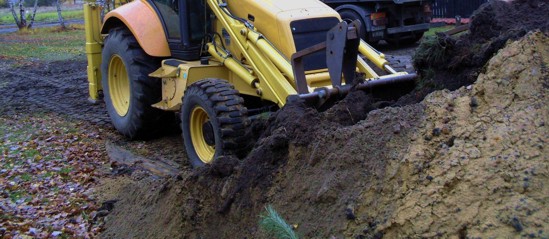
The next step is getting rid of the weeds. The easiest method is to spray with a total herbicide, e.g.. Roundap, or a mixture of herbicides. After approx. 2-3 weeks after spraying, the weeds can be mowed and the next works can be started, that is, ground leveling. Leveling is generally performed with heavy equipment. You should remember about this when leveling the terrain, that if the soil on the plot is not fertile (comes e.g.. from the trenches), it will be necessary to leave room for the humus, which will be delivered. The ground level after leveling should therefore be lower than assumed as much as the humus is delivered. When giving the plot a shape, let's remember about it, that slopes should drain rainwater outside the plot and should not be directed towards buildings. A good solution that facilitates the drainage of rainwater is the installation of drainage trays to collect and drain the water. In case there is a high level of groundwater on the plot, hardly drained clay and clay soils, or it is not possible to drain rainwater by means of slopes, it may be necessary to install a drain. Drainage water can be drained into the trench, watercourse, or wells, from which you can use it, for example. for watering the garden.
 When the work related to leveling the ground is completed, it remains to bring the fertile soil, that is, humus. Depending on how we plan to develop the plot, a different amount of humus will be needed, for example. if the soil on the plot is barren, it should be at least for planting 30 cm, and for lawns, in turn, it is enough 10-15 cm. The level of fertile soil should be equal to the level of other surfaces, because the humus will settle down by approx. 10-25%, thanks to which the level of e.g.. the lawn will be 2 cm lower than the cobblestones, so that its turf does not grow beyond the curbs.