Clematis – beautiful creepers for small gardens.
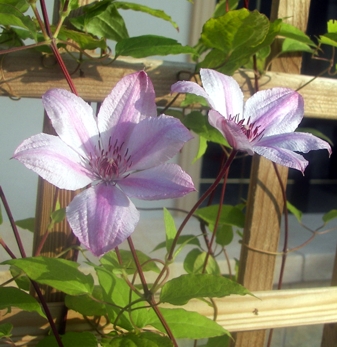
Clematis also called clematis are popular creepers, or less often perennials, for which there should be a place in almost every garden. Clematis are plastic plants and take up little space using vertical space, thanks to which they work especially well in small home gardens, and even on terraces and balconies. The biggest advantage of these plants is a long and very effective flowering in almost all possible colors.
Among the species bred in Poland, large-flowered clematis with large, or very large flowers. Numerous varieties of these creepers reach from 2 do 4 m in height. Large-flowered clematis is quite a demanding group of plants when it comes to cultivation. They need fertile, humus and constantly moist soil. These creepers can be susceptible to diseases (especially the collapse), and during very cold winters they can partially thaw. However, the difficulties of cultivation will certainly be compensated by huge amounts of large, spectacular flowers, that can stay on the plant from late spring, until the first frost.
Slightly less popular than large-flowered clematis are botanical clematis. Varieties of botanical species generally grow faster than large-flowered varieties, reaching up to several meters in height.. At the same time, botanical varieties are more resistant to diseases and have lower soil requirements. At the same time, botanical clematis have smaller and not as spectacular as large-flowered varieties of flowers.
How to care for clematis
Clematis are plants, the cultivation of which can be quite troublesome. Especially difficulties in breeding are encountered in the case of large-flowered varieties. It is crucial to provide plants with the right growing conditions. Clematis require fertile, humus and constantly moderate soil. They hate drought, as well as frequent flooding. The light requirements of clematis are average and should not actually grow only in deep shade.
Clematis is planted in the immediate vicinity of the structures on which they will climb. It is important that the elements of the supports are thin enough for the plant to wrap itself around them with a petiole.. The shape of the supports does not matter, you just need to remember to properly choose the variety for the space to be covered.
An important breeding procedure to ensure effective flowering and proper form is clematis pruning. They are performed in late autumn, or in early spring and consists in a very strong shortening of shoots. In principle, clematis shoots after cutting should have from 30 do 100 cm, that is, from 2-3 up to several healthy pairs, strong buds.
The use of clematis
Clematis is used both in small home gardens and in public greenery. Clematis are perfect for English gardens, naturalistic, forest and rural.
Clematis is especially useful wherever space is limited. The way they grow can be freely regulated by shaping the supports that grow. Clematis should be used to mask unattractive parts of the garden, for arranging terraces, Balconies, on the patio, for covering gazebos and for creating intimate rest interiors. Clematis can be used to plant pergolas and trellises to create green walls separating garden interiors. An interesting way to use these creepers is to plant them in the immediate vicinity of trees and shrubs, on which they will climb creating very original compositions. In general, clematis is worth planting in exposed places, so that you can admire their spectacular flowers up close.