Plants for a beautiful hedge
Hedges can be found in almost every garden. They perform many functions m.in. protect the interior of the garden from the wind, Dust, dust and street noise, but also the views of neighbors. In addition, hedges can be used to organize the interior of the garden, or to obscure its unsightly fragments. Hedges can be set up from many plant species and run in different ways. Depending on this, whether the hedge is cut and what form the cut has, we distinguish hedges:
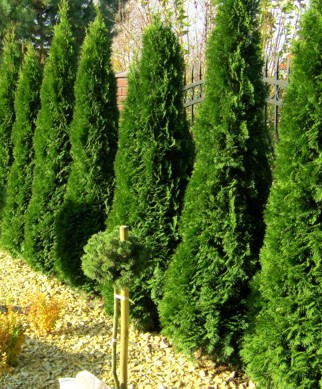
- not formed – plants are not cut and grow freely. For such a hedge, some deciduous shrubs are great, and columnar conifers, e.g.. thuja Smaragd.
- partially formed – plants are formed, but retain their natural habit. For such a hedge, the same plants as for an unformed hedge are suitable.
- formed – plants in such a hedge grow very close to each other and are often sheared into geometric forms. For such hedges yews are suitable, boxwood, Thuja Brabant, Thunberg barberry, common ligustr, common hornbeam, common beech and double-necked hawthorn.
Knowing what functions the hedge will perform in our garden, you should carefully select plant species, from which it will be created and plan how to densely plant plants. Below is a list of the most valuable plants for hedges, which certainly works well in the conditions of Rzeszów and the surrounding area.
Plants recommended for hedges
- Western Life (Thuja) Smaragd – intensive plant, emerald green, very dense, narrow-columned, thanks why there is no need to cut it. It grows quite quickly. When the intended height of the hedge is reached, you can trim its tops, as a result, the plant will grow more slowly. To quickly achieve a compact hedge of plants should be planted every 0,6 – 0,8 m. One of the best plants for high shielding hedges.
- Western Life (Thuja) Brabant – wide, loose, fast-growing odmaiana thuji. Suitable for molded hedges. Regular haircut makes, that it thickens strongly and forms a compact green wall. The recommended planting spacing is 0,7 – 0,8 m.
- Western Life (Thuja) Aureospicata, Europe gold, Yellow Ribbon, Aurescens – varieties that grow quite strongly, ovoid and greenish-yellow, or yellow colour of scales. They can be used to create a formed hedge such as the Brabant variety, but also partially formed, or not formed.
- Common yew, Boxwood evergreen – plants that tolerate cutting very well, but relatively slow-growing. Sensationally suitable for low sheared border hedges. For one running meter of the hedge should be planted at least 6 plants in two passing rows.
- Thunberg's barberry – medium size, thorny bush, which has a lot of colorful-leaf varieties. Depending on the purpose and variety, you can create a molded hedge from it, partially formed and not formed, medium high and low for different purposes.
- Hornbeam, Beech ordinary, Double-necked hawthorn – deciduous trees suitable for high formed cover hedges. Beech and hornbeam, often do not drain leaves in autumn, So, the hedge is a dense wall also in winter. Hawthorn has thorns, which makes the hedges from this plant particularly difficult to cross. To create a compact hedge should be planted in two rows 6 beech seedlings, grabu, or hawthorn per one running meter of hedge.
- Japanese Tawula, Shrub cinquefoil – low, Dense, flowering shrubs suitable for partially formed border hedges, or unformed.
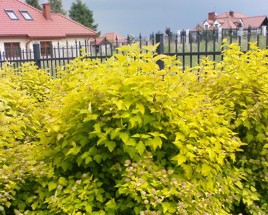
- Kalinolistna bladderwort – medium-sized shrub, having colourful-leaf varieties. Suitable for colorful partially formed hedges, or not formed. Density of planting in a hedge from 0,5 up to 1m.
- Early Tavula, van Houtte and grey – deciduous shrubs spectacularly, white-flowering in May. Suitable for medium height hedges not formed and partially formed, whereby the cut should be made after flowering. Planting density as in the case of physalis.
- Miraculous shrub – deciduous shrub with numerous colourful-leaf varieties, spectacularly blooming in early summer. Purpose and planting as in the case of physalis and tawuls. It is necessary to cut after flowering.
- Intermediate forsythia – a medium-sized shrub very impressively blooming in early spring. Destiny, planting and cutting as in the case of tawul.