Garden irrigation systems.
We provide design services, installation and maintenance of garden irrigation systems. The irrigation systems we install are fully automatic and professionally made, so you can save time and not worry about it, that the plants in your garden will wither.
We make irrigation systems from components from reputable companies such as: Rain bird, Hunter, K-rain i Wethermatic.
If you want to know more about garden irrigation systems, please read the next section.
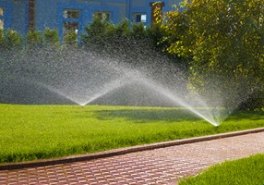
What the irrigation system consists of
The automatic irrigation system consists of several parts. The first is a system of pipes distributing water around the garden, at the end of which there are watering elements, which are sprinklers, drip lines, or micro-spray. Various types of watering devices are used for watering various types of vegetation, and so for watering lawns and low vegetation, a pop-up sprinkler of various types is used (static, rotational), drip lines can be used for watering dense groups of plants (pipe, with a system of holes, the so-called. drippers, through which the water flows directly under the plant roots), and for single watering, micro-sprinklers can be used for larger plants. In addition to pipes and watering devices, the irrigation system also has a series of valves, and the so-called. “dehydrators” (automatic drain valves), which facilitate its maintenance.
The second part of a garden irrigation system is automation, which controls the system. It consists of the driver, rain sensor, humidity, or weather station and solenoid valves. These devices are responsible for providing plants with the right amount of water, at the right time.
The entire system is divided into sections. Individual sections are responsible for watering individual parts of the garden. Each section, has its own system of water distribution pipes terminated with devices of one type, e.g.. static sprinklers, or drip line. The working time and the amount of water for irrigation for each section are regulated by the controller, which is connected with devices that check the current weather condition, yes, in order not to water the garden, e.g. during rain, frost, or a gusty wind. The control room opens, or closes the solenoid valves at the beginning of the supply pipes.
The irrigation system is divided into sections for two reasons. The first is the different water needs of different types of vegetation, in different parts of the garden. Another fact, that it is difficult to find a water source that is efficient, to water the entire garden at once. For this reason, the garden is watered “in installments”, using less efficient water sources.
Water for watering the garden. Where to get it?
A very important issue, in the design and installation of the irrigation system, there is a source of water, who will power him. Issue, is important, because it has a decisive influence on the costs of watering the garden.
The most easily accessible source of water is, of course, water from the aqueduct. Unfortunately, watering a garden like this is quite expensive and may not be acceptable for a larger garden. However, if we decide on such a solution, it is very important to install a separate water meter,to which the system will be connected, so you can avoid the fee for the discharge of sewage to the sewage system.
A much cheaper solution than mains water, there is water that comes from the well. In this case, we only pay for electricity to power the hydrophore. Your own well in large gardens is the only rational source of water for the irrigation system. If we have it on the plot, all that remains is to connect a hydrophore with appropriate parameters and you can install an irrigation system. If there is no well, then, it has to be dug up. The cost of building such a well can be very different. The cheapest will be, if there is shallow groundwater on the plot. We can drain water from the roof of the building and drainage to the well. In the case of watering the garden with water from the well, its quality is very important. Strongly rocky water, or containing a lot of iron is not suitable, because it clogs sprinklers and drippers very quickly.
Advantages of irrigation systems
Irrigation systems have a number of advantages, thanks to which the costs incurred for their establishment are quickly recouped. The most important of them is:
- convenience – We do not have to spend the summer 2 hours a day to water the garden – the system will water the garden for us
- regularity of watering – the irrigation system waters the garden whenever it is needed, preventing the plants from losing too much water. You can easily go on vacation and not worry about the condition of the lawn when you return.
- watering time – the irrigation system waters the garden at the most appropriate time, which is generally early morning. Few people want to get up at the hour 5 water, to water the garden.
- saving water – irrigation system uses less water to water the garden, than when watering with a hose and at the same time distributes it more evenly. Particularly large savings are guaranteed by the use of drip lines and micro-sprinklers for watering plants.
- healthy appearance and rapid plant growth – thanks to this, that the irrigation system works very regularly, the plants are constantly well supplied with water. If we have an irrigation system in the garden, combined with the appropriate fertilization of plants, we can achieve amazing results.
- -durability and reliability – if the system is well designed and solidly assembled with good quality components, you can be sure, that it will serve for many years without failure.