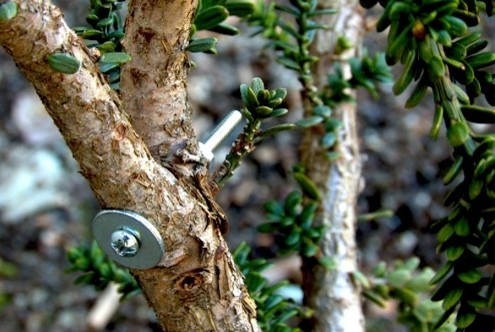
 Fractures occur as a result of various loads, the size of which exceeds the strength of the wood. Such overloads most often occur during very strong winds’ affecting the tree in its leafy state or as a result of icing on the branches after falling frosted rain, due to the action of snow coat caused by freezing of falling wet snow, etc.. Fractures occur most easily in the places where the wood tissue is damaged and can take various forms.
Straight fractures in a short distance are the least serious. It is enough then to cut off the broken branch in the right place below the fracture in accordance with the principles discussed above. If the fracture is close to the branch, the remainder is usually cut off at the root. If, on the other hand, the fracture has occurred in the upper part of the branch and there is no branching in the long section, the cut can be made below the fracture. They grow out of the buds of the sleeping people very much then, strong, shoots, the growth of which has a great influence on the formation of the wound-healing tissue and on the reconstruction of the broken part. Some of these shoots formed into branches should be removed in the following years in order to ensure the proper shape and structure of the crown.
Fractures with a long split reaching the trunk are much more dangerous. The wound resulting from severing the fracture sites then consists of the cut plane and the wood splitting plane. It would be too much of a waste to cut off the entire limb, especially, that the remainder can provide a good construction basis for young branches to regrow.
This damage is difficult to prevent, but possible by mechanically appropriate shaping of the crown and preventing the decay of the wood in the places removed when cutting branches. Sometimes such fractures can be prevented by making special bindings, which have been discussed in other articles.