How to use conifers in an interesting way?
In addition, the color palette among coniferous plants is limited to green, yellow and blue – there are no varieties of conifers, which would be red, orange, Pink, or brown. Wanting to have red accents in the garden we are forced, to complement coniferous plants, eg. deciduous shrubs. When creating a diverse and dynamic garden, compositions from coniferous plants must be composed with fantasy using many of their forms and colors and complementing conifers with other groups of plants.. Here are some examples of good use of conifers.
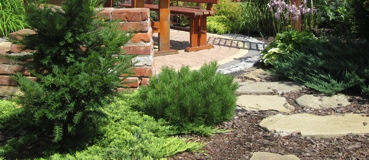
Mixed compositions from conifers and other plants
A great complement to the composition with a predominance of coniferous plants are generally colorful and flowering deciduous trees and shrubs, decorative grass, perennials and heather plants. Especially well as a complement to the composition of coniferous plants will work intensively flowering plants and with leaves in various shades of red.
When arranging larger coniferous plants, remember to be interspersed with deciduous trees and shrubs as far as possible, herbs, shrubs and other plants. Conifers will look best in small groups consisting of several plants of different sizes, shape and color between which plants from other groups grow. At the same time, coniferous plants can be a sensational background, used to expose flowering plants, e.g.. blooming azaleas will look great against the background of dark pines.
Another solution is to create a composition from one large coniferous plant (tree, or a large bush) surrounded by much smaller perennials, ornamental grasses and small deciduous shrubs. Mixed compositions of dwarf conifers with the character of rock gardens also look beautiful, or gravel supplemented with small perennials and deciduous shrubs, shrubs, eg. heather and small ornamental grasses.
Coniferous plants as solitiers
There is a whole range of coniferous plants, which we can use as loners, or solitiers. For solitiers it is worth using large plants with an interesting shape, Likes, or colour. The loner should grow singly against the background of a large lawn plane, so that it is he who attracts the attention of people staying in the garden. A good example of conifers suitable for solitiers are the blue varieties of prickly spruce Koster and Hoopsi, Korean fir Siberlock, or such varieties of dense-flowered pine as Glauca, or Oculus draconis
Compositions from ground cover conifers
Many coniferous plants, e.g.. numerous junipers work great as ground cover plants. Choosing two, or more varieties of different colors and heights can create a mixed composition, which will certainly be more interesting than the doe of a single plant. In addition, higher deciduous plants with colorful foliage can be woven into the coniferous cover sheets, or conifers with a strong, structural shape.
Varied hedges of coniferous trees and shrubs
A hedge of coniferous plants does not have to be monotonous, uniform wall. There are many possibilities to create diverse hedges from two, or even several plants, where selected species and varieties may have similar, as well as varying growth rates. You can create a hedge, in which two plants take turns, e.g.. green and yellow thuja, or those in which an accent appears every few plants, eg. in the hedge of yellow-needle thuja appears every few plants much higher and darker Serbian spruce.