Which plants to choose for shady places?
Shaded areas are very specific parts of the garden, which during its design requires a lot of knowledge and an appropriate approach. The specific microclimate of shady places with little light and increased humidity makes, that vegetation for such places should be chosen very carefully and deliberately. One should remember, that the lawn in shadowy places generally grows poorly, it is rare and moss appears en masse in it. In turn, many woody plants, especially conifers in the shade grows poorly, it does not stain adequately and shows an increased susceptibility to diseases. So how to choose vegetation for shady places? Here are some suggestions.
Lawn in a shady place
Although lawns in shaded areas generally look poor, it can be remedied at least partially. Keep in mind when setting up your turf in the shade, to absolutely use blends intended for shadowy places. The second issue is proper lawn care, which requires careful scarifying, liming and fertilizing with fertilizers that do not acidify the soil. Such treatments help get rid of moss and give more room for grass to grow.
Cover vegetation
An alternative to a shade lawn is ground cover plants. There are a number of plants, which perfectly cover the soil in the shade. Shrubs such as numerous varieties of horizontal cotoneaster and dammer deserve attention, Chaneult Hancock's snowball and Crisp's crumpled tavern. These shrubs expand widely and quickly cover the surface with a dense carpet of shoots. Ivy is an excellent ground cover plant for shade, whose shoots crawl on the ground, growing to it, creating a dense carpet of dark green leaves. Other plants, which are perfect as ground cover plants in the shade are Japanese marshmallow, periwinkle and yellow gamekeeper.
A hedge in the shade
Several plants are especially valuable for setting up hedges in shady places. Common beech and hornbeam are perfect for deciduous hedges in the shade. In turn, a coniferous hedge can be set up from common yews, or indirect, possibly from a Canadian Christmas tree.
Conifers in the shade
Although most of the conifers are usually very light-loving plants, there are several species, which do great in the shade. They include almost all fir trees, including Korean firs popular in home gardens, Normal, Californian and mountain. Another conifer, which grows well in the shade is the Canadian pine. Among the coniferous shrubs, numerous varieties of common and intermediate yews and the Japanese thuja are perfect for shady places..
Color-leaved plants in the shade
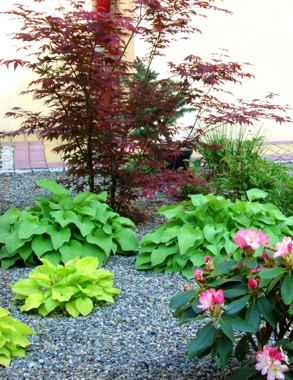
Although plants with colored leaves growing in the shade generally do not color intensively, there are a few plants, which is worth introducing to the composition of a shadow corner to diversify it in terms of color. An interesting accent will certainly be the colorful-leaved palm maples, white dogwood varieties with white leaves, e.g.. Elegantissima and numerous varieties of multi-colored funkia.
Shade-blooming plants
It is worth to diversify the shady part of the garden with flowering plants. Rhododendrons blooming spectacularly will feel great in shaded places, garden piercings and hydrangeas. Among the larger shrubs, numerous species and varieties of viburnum and jasmine are perfect. In turn, from flowering perennials for shade, it is worth choosing a funkie, daylilies, cheap, Przewalski's tongue and peonies.