The binding elements are usually steel bars of thickness 10-12 mm passing through the tied pins through and terminated with nuts with large p-shaped washers preventing squeezing into the wood.
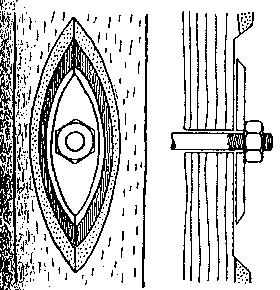 The shape of the pad and its arrangement in relation to the pulp plane.
The holes in the trunks must be drilled in the same straight line as the direction of the bar . The plane of the rootstock should be lowered in relation to the plane of the pulp, which enables it to grow over. In hardwood trees, the tie bars may be attached to thick hooks screwed into the trunk 10-12 mm, ended with a bend or a circle. This method is easier to apply, because it does not require time-consuming and difficult drilling holes. Before establishing the binding, the joined limbs should be slightly pulled towards each other by means of a rope. This results in a slight tension in the bond, which is the condition of its operation. All parts of the bond should be protected against corrosion. The places where the washers are placed should be completely covered with orchard tar.
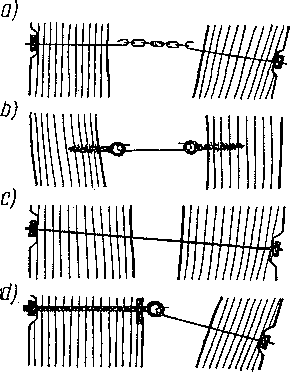 Methods of tying two branches: a) steel bars connected by a chain, b) screw hooks, c) with one steel bar, d) two rods ended with a circle and a hook.
Attaching bindings, as is cutting at high altitudes, can be performed by specially trained personnel, using appropriate tools and following the rules of work safety.