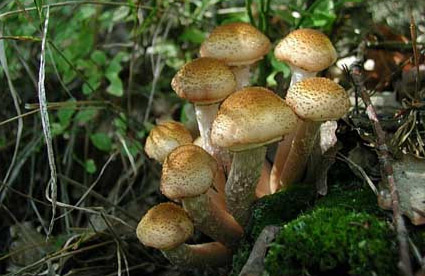
 Honey fungus – open, agaric mushroom, opieniak, chimney pan, subscriptions, ringlet, tree stump, scapula, armillaria birch
secondary value mushroom. It has a hat with a diameter of 3…10 cm, honey color, on the surface dry, covered (especially at the top) tiny scales. The gills are colored like the hat (slightly brighter), different lengths, slightly running down the shaft. The body is the same color as the whole fruiting body, sometimes yellowish at the base, slender, lengths up to 20 cm, often widening downwards. There is a distinct ring on the stem. Yellowish flesh, somewhat stringy (especially in older specimens), with a mild flavor (a bit sour), but leaving a harsh aftertaste. Smell faint, enjoyable. White spore discharge.
Pretty common, it grows in groups, often as a harmful parasite of trees (especially in mountainous areas).
It can also grow on the ground, near trees. Harvested mostly from mid-September to the end of November. It contains substances that are harmful to some people, so you have to pour out the water after a short boiling. A similar species appears in deciduous forests on the ground and on rotten stumps – armillaria unstable, which does not have a ring on the shaft.
Armillaria honey and its varieties are often confused with mushrooms of other types, np. with poisonous bundle buttermilk, wearing a yellow hat, a yellowish or greenish gills or an inedible shell with a brown cap, covered with scales (similar to armillaria) and a shank with a ring and also with scales. The smell of this shellfish is similar to that of a radish.