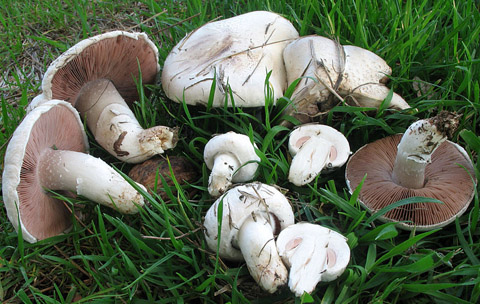
 Meadow mushroom – real mushroom, stamp, baker, baker, champion
first-class mushroom. It has a hat with a diameter of 4…10 cm, whitish, in places with an ocher tinge, smooth, dry, in young specimens rolled up from the edge. Initially pink gills, later brown, densely arranged, narrow, free. The body is whitish, tapering at the bottom, full, relatively short (3…5 cm), bears a ring, which in mature specimens has the form of a double ring. White flesh, slightly pink after breaking (there are varieties with a stronger pink color), in a fat hat, massive, compact, with a mild taste and a pleasant smell. Chocolate-brown spore discharge.
Pretty common, it grows on the edges of roads, in parks, next to garbage cans, and even in city streets by paving slabs. Harvested from June to mid-October.
The cultivated common mushroom has a single ring on the stem. The color of the hat can range from white to brown. Dark pink lamellae, straight shaft, extended at the base. In addition to the two-spore mushroom, three strains of the thermophilic four-spore mushroom have been cultivated on an industrial scale in recent years.; also a meadow mushroom (with darker gills) became a cultivated mushroom. The field mushroom and the bush mushroom are also the edible ones.
There are also poisonous mushrooms: flat, similar to p.l., with a stem bulbously extended at the base, about the flesh that changes color to chrome yellow after breaking and has an unpleasant smell (ink or carbola, especially intense during cooking) and yellowish (with a yellowish or brownish tip), which stains yellow when rubbed off. The taste and smell are unpleasant – karbolowy. Meadow mushroom and its varieties are often confused with young fruiting bodies of white toadstools, which, however, have white plaques and a sheath at the base of the shaft.