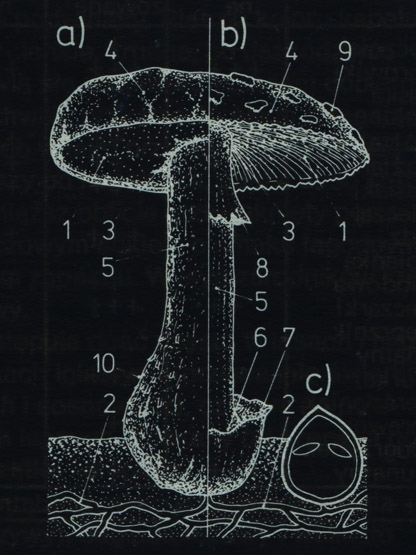
 Diagram of a typical fruiting body of a cap mushroom and its main aboveground and underground parts: a) a mushroom fruiting body with a tubular bladder (e.g.. boletus);
b) mushroom fruiting body with lamellar veins (e.g.. toadstool); c) young,undeveloped mushroom fruit body
1 – veil (hymenial layer), the most important part of the fruiting body, in which spores are formed on the bases (invisible to the naked eye) color from white to black. This layer can be created on special structures in the form of plates, spikes or tubes forming the so-called. hymenofor; 2 – mycelium, the vegetative body of the fungus, in the form of hyphae (forming a loosely or strongly intertwined shapeless mass, less often of a specific shape). It develops on the surface or in the depths of the substrate, can spread in the litter a distance of several meters; fruiting bodies grow out of it.
In some species the mycelium produces spores, allowing for the survival of unfavorable periods (e.g.. lack of water);
3 – flesh of different consistency (fleshy, cartilage, spongy, flexible, fibrous) filling the inside of the fruiting body.
In some mushrooms, e.g.. lactate, milk tubes run through the flesh, filled with white or colored liquid; 4 – hat, it can have a different shape: spherical, the ista hemispheres, conical, flattened, concave, funnel-shaped, fan-shaped. On its surface there is a skin made of compacted hyphae; may be covered with mucus, suede, shiny, dull, smooth, papillary, scaly. Its color can change under the influence of various factors; 5 – stem, it can be placed centrally or to the side of the hat; may be barrel-shaped, cylindrical, clavate, fusiform. The base of the shaft is sometimes hairy or tipped with a shield, elongated in the form of a root or bulbously extended. The inside of the shaft may be solid, chambered or tubular; in older fruiting bodies it can become spongy and soft; 6 – spherical base of the shank (only in some species); 7 – vagina or just a trace of it (only in some species); 8 – ring on the collar, formed from the upper remnant of the cover, where the fungus was growing (only in some species);
9 – visible hyphae (only in some species); 10 – dots, strands, mesh on the shaft (only in some species)