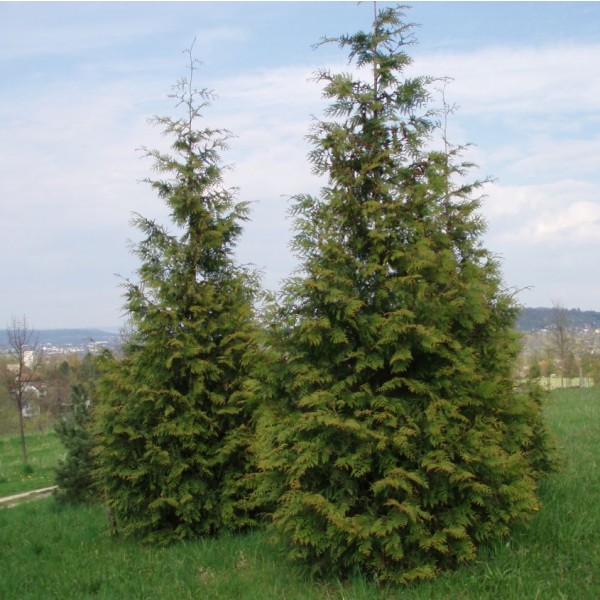
 Giant thuja (Thuja folded)
Appearance; Evergreen, monoecious coniferous tree with a crown, usually slender, narrow, conical and quite regularly developed; in older trees it widens very much at the base. It reaches a height of up to 30 m, occasionally to 40 m, and in the area of origin even to 60 meters.
The branches stick out straight at first, later, in the upper zone, the crowns rise, and at the base they also hang down, touching the ground frequently. Dark reddish or brownish-brown bark, clearly longitudinally furrowed, splits into longitudinal stripes or falls off tiles,
The branches have different colors on the top and bottom {an important distinguishing feature of the species). Scale leaves on a cross opposite, both side (Outside) always slightly longer than the middle ones (inside). They have approx 3 mm long and fit snugly to the twigs. 2 front lupus, obovate in outline, shiny on top, green or dark green, on the underside much brighter and with a delicate whitish pattern. They give off a distinctly sweet pineapple smell when rubbed.
Very small male flowers, yellowish cones on single tops of shoots. Light brown female cones when mature, with open and protruding scales, extending into a thorny apex are approx 2 cm in length.
Occurrence; Originally only in western North America, from Alaska to California, in the forests of the Coastal Mountains and the Rocky Mountains. The species is often planted in parks and larger gardens as an ornamental tree. Flowering period March.
General thoughts; The trunks of the giant thuja were especially eagerly used by North American Indians to make canoes (dugout) from one trunk and totem piles. Later settlers used them as a building material, eagerly used in the construction of buildings from whole logs,
Related species:
Korean thuja (Thuja koraiensis) It differs from the previous species with its flat twigs shining silver from the bottom; no other Thuja species has such branches. The species is still not often planted in gardens and parks. The leaves of this tree give off a smell that is somewhat reminiscent of marzipan when rubbed. Japanese thuja (Thuja standishii) it has a wide conical crown with branches arranged in the shape of a candelabrum and a copper-red bark. All the green parts give off the scent of eucalyptus candies mixed with lemon when rubbed. The female cones are long 13 mm and are brown like a cigar. This species can be found here only in parks and botanical gardens.