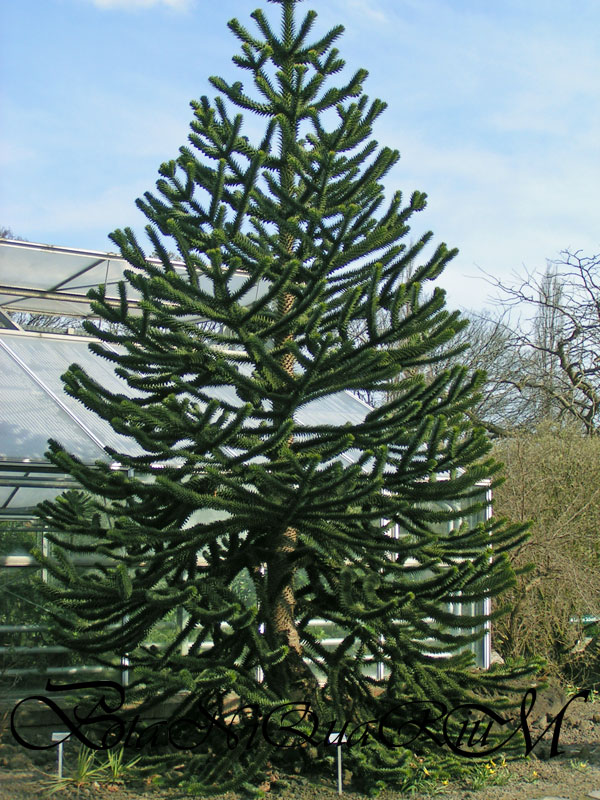
 Araucaria (Needle) Chilean (Araucaria araucan)
Appearance: Evergreen, a dioecious coniferous tree with a round crown, oval or wide conical on the oval, a very straight and slender trunk. In his homeland, it reaches a height of up to 50 m, in U.S – rarely over 10 meters.
Branches only in whorls, very slender and long, they are relatively poorly branched, straight out or slightly hanging down, only at the top of the crown – facing up.
Dark bark, brown-gray is divided by transverse furrows by the base of the dead, fallen branches or wrinkled, sometimes with numerous drops of resin.
Pins set densely on the branches, spirally, have about 3-4 cm long and are almost as wide, triangular or oval in outline, front with short, slender top, quite stiff and leathery, dark green and sometimes shiny on both sides, all directed towards the top of the shoot. Male flowers in small clusters at the end of the shoots, they stay on the tree for months. Very large female cones, spherical or slightly oblong, thickness up to 17 cm. they stand straight on thicker branches, remaining green until the second year after pollination. Only later do they turn brown and break up into individual scales on the tree, Brown seeds approximately 2 in size×4 cm are edible and very oily.
Occurrence: The homeland of araucaria are the Chilean and Argentine Andes, where it forms dense forest stands on the slopes. In the Mediterranean area it is often planted in parks and home gardens as an ornamental tree. Beautiful specimens can also be found in southern England and Ireland. In Germany, araucaria survive the winter only there, where the climate is particularly mild (for example in the Rhineland),
Flowering period: From June to July.
General thoughts; The Araucaria family is a family of conifers with only two genera of z 36 species found only in the southern hemisphere, on all continents except Africa. In the plant system, this family occupies a somewhat isolated position, due to the special structure of the flowers, not resembling the flowers of other conifer families (for example Sosnowatych). The genus Araucaria presented here is represented in South America by two, and in the world by 18 species; most of them are found in the wild in Australia and New Guinea. Due to this, that it takes peculiar forms, araucaria is often used as an ornamental tree plant. It is impossible to confuse it with any other coniferous tree. Araucaria are often referred to as "Chilean ornamental fir."” – misleading and botanically incorrect name.
Unlike many other conifers in araucaria, the cotyledons remain in the ground during germination, As a result, the young plant is now normal, foliage typical for the species.