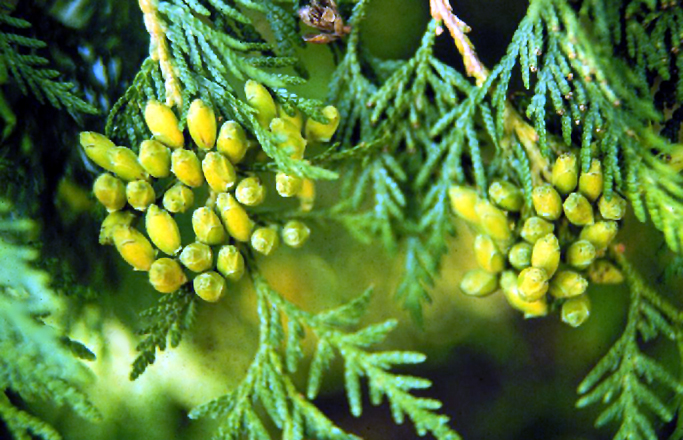
 Western thuja (Thuja)
Appearance: An evergreen coniferous tree, with a height of up to 20 m, with a narrow one, conical, always a slightly rounded crown at the top. Branches and boughs quite loosely spaced. Twigs usually slack, a bit dangling, always clearly brighter on the bottom than on the top – or (in many forms) almost yellowish, no whitish drawing.
The bark is lighter or darker orange-brown, it gradually becomes gray-brown in older trees, with clearly longitudinal cracks.
Scale leaves on a cross opposite, wide, oval, without a clear tip, it smells like apples or apple sauce with cloves when rubbed.
Small male flowers, oblong, dark red, placed at the ends of the twigs. Initially, female cones are yellowish, green-brown when ripe, consist of 8-10 scales opening upwards; length 10-12 millimeters.
Occurrence: Western thuja is – along with the giant thuja – one of the most important conifer trees in North America. Occurs in the east of Canada in the Great Lakes region and in the parts of the United Sianów adjacent to the south. The ranges of both species are separate. Western Thuja is widely used in Europe in numerous varieties as an ornamental tree plant. It is perfect for trimming, that is why it is eagerly planted as a hedge, Besides, it comes in numerous forms – also dwarfs – in the gardens.
Flowering period: March to April. General thoughts: American thuja species are strong, however, relatively light wood, can be processed very well. Therefore, it has many uses as a building material (formwork, gonty, fences, and also Indian canoes carved from a single trunk). As with many other species of conifers, the heartwood is intensely reddish brown, however, it brightens significantly after a while and becomes almost silver in the air. The white is light yellow to off-white. and after treatment it becomes slightly darker.
A related species; The Japanese hyba is quite closely related to the genus Thuja (Thujopsis dolohrata). A striking feature of this Japanese tree is its rough bark. looking scratched. Scale leaves are approx 5 mm in length and are triangular in outline with a wide base, not clearly pointed and slightly bent, very densely arranged, with a whitish pattern on the underside, and shiny dark green on top. They give a very pleasant smell when rubbed. Female cones approx 1.5 cm, spherical, composed of a few disc's scales. The species is sometimes planted as an ornamental tree.
The remarkably slow growth of this species is noticeable, very different from the generally intensive wood production of its close relatives.