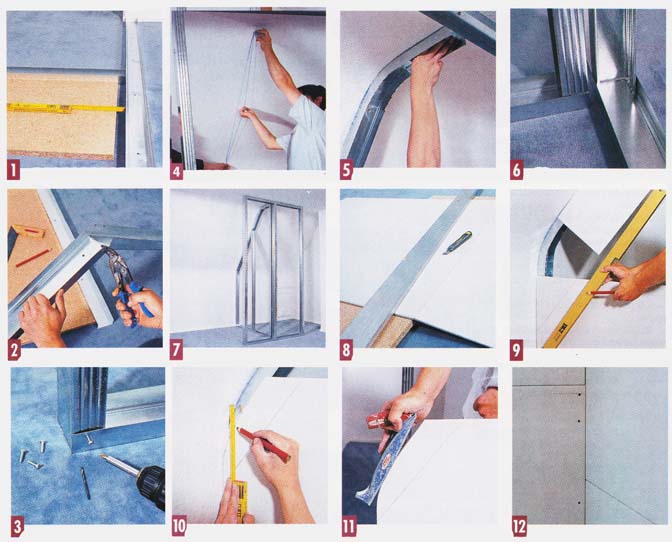
 1. A wooden plate about the size of a rack shelf helps to position the rack. Its dimensions do not include the thickness of the plasterboards.
2. Metal profiles are cut with sheet metal shears. Be careful when doing so, because the cut edges are sharp.
3. Vertical C-profiles are attached to the U-profiles attached to the floor and ceiling with simple sheet metal screws.
4. String to the meaning, that is, a rope smeared with colored chalk flour, the exact position of the U-profile on the miter is determined.
5. The U-profile can be bent according to the angle of the roof, after multiple cuts (full width) its side panels.
6. Leave a gap between the profiles, allowing you to slide the entire plasterboard into the frame and fix it to the frame.
7. To ensure the rigidity of the structure, vertical C profiles are set up at least every once in a while 50 cm, according to the principle: better too much than too little.
8. With a bookbinding knife, the surface of the plasterboard is cut and the board is broken on a pad with a sharp, long edge.
9. According to a rectangular piece of plate applied to the miter, the angle of the roof inclination is drawn on the lower one, disc to be matched.
10. The board is cut according to the marked line, and then use a ruler and a pencil to draw the shape of a corner rounding.
11. The rounding adjusts to the angle of the roof with a special plane for porous materials and plasterboard.
12. The boards are placed in this way, so that their joints do not meet each other directly and do not form so-called cross joints.
By purchasing materials in a DIY store, it is best to opt for handy plasterboards intended for work carried out by one person. They have dimensions 1 x 1,5 m and thickness 1 cm, making even moving them in narrow spaces much easier.
If we want to accurately measure the height of the room, we should use two meters: place the first one vertically on the floor, v and press the other one against the ceiling. They should be positioned in this way, so that the numbers on the upper scale go down. The result is read at the cue point 2 m on the lower meter.
Profile U and C
They are metal profiles, which are used to build frames for light partition walls. Profile U (which in cross-section resembles the letter U) is attached to the floor and ceiling and serves as a support for slightly narrower C profiles (identical cross-section, but the edges of the walls are additionally bent to the inside of the profile), that is, the vertical elements of the structure.