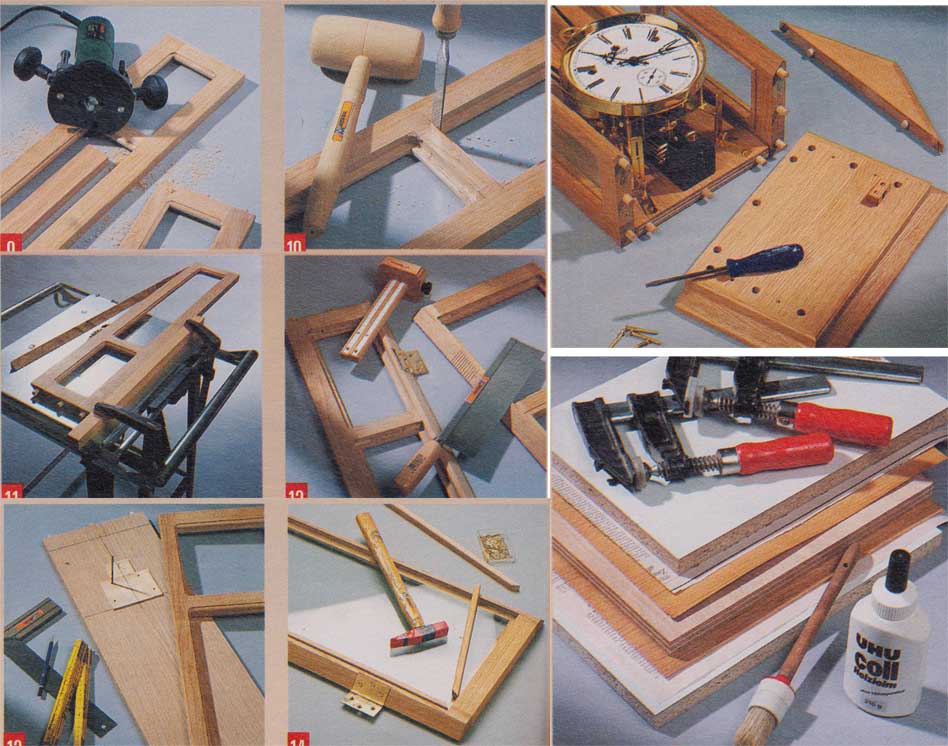
 After connecting the individual elements of the frames with glue and wooden pegs, carefully finish all connection lines with a plane, remembering about it, so as not to leave any faults. Any possible unevenness will cause inaccuracies when milling decorative profiles and rebates for glass tiles on the underside of the frames. Then cut with a table saw at an angle 45 steps, the door and the front edges of the side walls of the housing. Only after inserting the hinges and inserting the glazing elements can the housing be connected to its rear wall. Finally, we will install a clockwork with a pendulum on it. If the mechanism is not an antique you bought at a flea market, but a contemporary product, should come with instructions, clearly explaining the method of attachment.
If we have a problem with buying properly cut veneered blockboards, let's replace them with plywood boards of the same thickness, self-covered with oak veneer. We grease them with wood glue, we lay the veneer, we cover with a layer of paper and a board washer, pressed in with clamps.
A profile cutter and a guide ring are essential, to contour the front edge of the frame. Support strips allow the cutter to be placed flat. The frame is wide 9 mm and depth 12 mm in the back plate under the glass pane is made with a milling machine. Finish all corners with a chisel and mallet. Position the saw blade of the table saw at an angle to trim the front edges of the side frames and both sides of the door. 45 degrees. We start the implementation of the side walls by inserting the fittings. Mark their location on the door, Cut the contour with a fine saw and hollow it out. Mark the fixing points of the clock mechanism and drill according to the template. Before that, we determine and mark the middle point of the clues. The strips and brass nails are used to attach the appropriately cut glass plate to the frames of the frame. First, drill the strips properly. After mounting the clock mechanism and pendulum on the back wall of the clock, The elements of the clock casing are fastened with screws, which will later enable all work related to its adjustment and repairs.