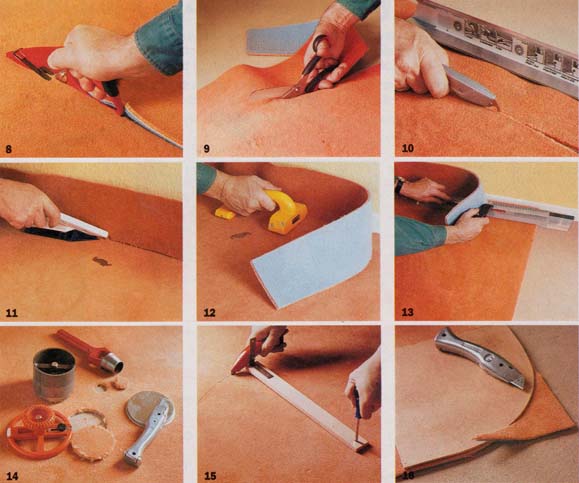
 8. Carpet knife (with covered blade and guide tip) it is indispensable when cutting thicker materials.
9. Curvilinear contours can be cut exactly with scissors, if you mark them beforehand with a felt-tip pen on the carpet, according to the appropriate template.
10. Hook knives are best for cutting light to medium thickness carpets. This is also their advantage, that they do not hurt the floors under the carpeting.
11. Thanks to the rounded bottom part, The carpet knife presses the material firmly into the corner between the floor and the wall, by making a cut close to the wall.
12. For thick material, which can only be pressed into an angle with more force, a hook knife equipped with two pressure bars is suitable.
13. With this simple device, mainly intended for cutting wallpaper, you can also trim carpets against the wall.
14. Cutting discs and punches are used in inserting years and ornamental patterns. The can lid can also be a template for cutting out circles.
15. Bows with large radii are cut with a compass made of a slat, an angle bar with a screwed knife and a blade forming the axis of rotation.
16. A hard fibreboard template is enough to round the corner of the carpet. The knife blade will glide easily over smoothly sanded edges.
The next step is to unfold and trim the rug, and then fit it into the door recesses. Then the lining strip is lifted upwards on one side, applies fixing tapes or glue and presses the material to the substrate. We do the same with the other part of the band.
If the room is that big, that it is impossible to pick up all half of the strand, Roll the carpet up from one end and fasten the sections one after the other 60 -80 centimeters, as the roll is unwound. Air bubbles, which may be forming underneath, should be squeezed towards the rolled-up part of the carpet.