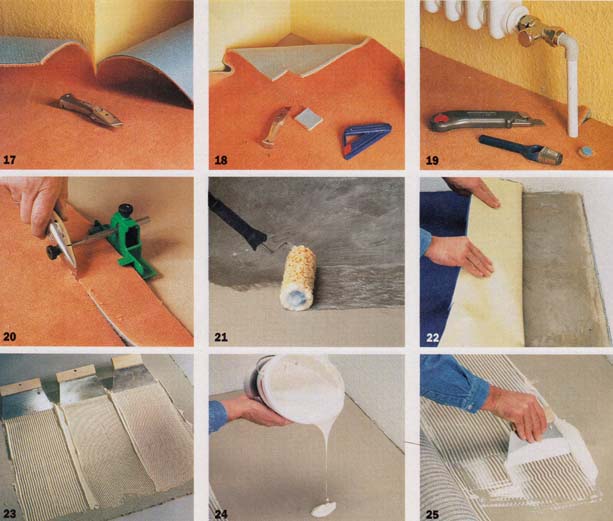
 17. At the outside corners, the raised carpet is cut at an angle of 45 ° all the way to the floor. Then both parts must be pressed against the edge of the wall and cut.
18. A corner square is cut in the corner like this, so that its top reaches to the corner of the room, both edges of the carpet are folded upwards and cut along the fold.
19. Using a punch, cut out carefully measured discs for pipes and radiator supports and connect the edge of the lining with each of them with one straight cut.
20. The strips glued into the plastic floor strips are cut with a special device with continuously adjustable cutting width.
21. Carpet glue has the same consistency as wallpaper glue. It is spread with a fur roller, and the cut material is placed on the wet layer.
22. A carpet laid on a special glue leaves almost no traces during removal. Glue residues are removed with a damp cloth.
23. The carpet glue is spread with a notched trowel, selected for the type of glued material as indicated on the packaging.
24. After uncoiling half of the carpet, a thick adhesive is spread on the substrate. In the case of larger surfaces, this work must be carried out in stages.
25. After the glue is evenly distributed with a toothed spatula, place the carpet on the wet layer and press it against the floor with your hands or with a roller.
Adhesive for spot repairs of carpets.
Carpet adhesives are usually sold in containers of at least 5 kg, that the reserve is sufficient to cover a larger area. For minor repairs, for example, a peel-off joint of two strands or a corner protruding from the PVC substrate, buying such a container does not make sense. That is why a special adhesive for carpet and PVC repair was introduced to the market, packed in small packages. The included spatula with notches is used to spread the glue.
Foam backs, commonly used in carpet coverings, are displaced by the non-woven backs. The easiest way to attach them is not to stick with double-sided adhesive tape, but connecting with "Velcro" type tape, glued only to the floor. The nonwoven fabric from the back of the carpet sticks to the tape under the blows of a hammer and does not come off when laid flat. If the material is raised at right angles to the ground, the connection is broken and the used floor covering can be completely removed.