Features of the lawn

Lawns are surfaces that are permanently covered with vegetation, ordinary grassland, created and maintained for various purposes. The features of the lawn that determine its aesthetic value include: uniformity, smoothness and lively green color.

Uniformity is understood to mean a type of plant that is homogeneous in terms of structure …
Ways of fertilizing trees and shrubs

Fertilization is effective then, when fertilizer can; be taken up by the plant. Therefore, each fertilizer should be placed in the soil in the zone of hair roots. The location of these roots varies and depends not only on the type of root system, but on the type of soil, …

Recommendations for fertilizing trees and shrubs

The need of various species of trees and shrubs for basic nutrients (N — nitrogen, P — phosphorus, K - potassium) is different. Approximately the proportions of these components are as 1,0 : 0,8 : 0,6. It is most expedient to use multi-component fertilizers, …

Fertilizing trees and shrubs

In natural and undegraded habitats, trees and shrubs use the nutrients circulating in a closed circuit. Fallen leaves or other parts of plants die and, after decomposition and mineralization, are whitened again by the roots in the form of mineral salts. Plant food cycle …

Wood losses, part 2

The following characteristics are required of such materials: low humble density, flexibility, thermal properties similar to wood, water-repellency, with sufficient mechanical strength and resistance to external factors. Moreover, such material should be cheap, easily achievable and easy to install. Due …

Wood losses, part 1

Wood losses occur as a result of its decomposition in places of various wounds: not cared for or improperly cared for. The most common place of rapidly progressing decomposition of wood are untreated wounds after faulty cutting of branches, exposed with their surface to rainwater. Cutting defect …

Damage to trees by electrical discharges – Thunder Strike

Very old and tall trees are most often damaged by electrical discharges, often towering over their surroundings. The size of the damage is very different and depends on such factors, how: discharge force, the species and size of the tree and the properties of the soil, such as a degree …

Frost cracks in the tree

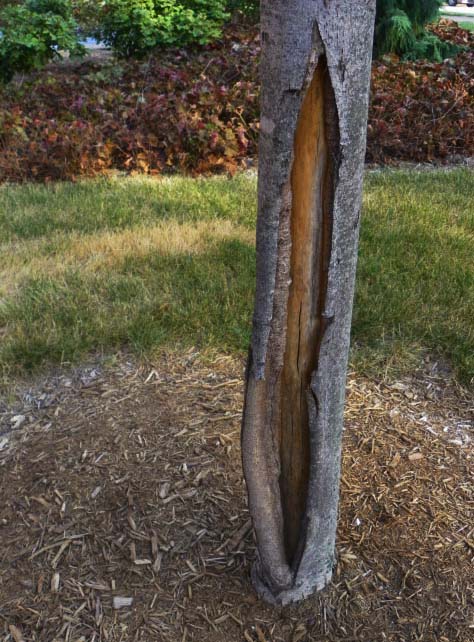
Frost cracks in the tree.

Frost cracks occur as a result of large temperature differences between day and night. During a sunny winter day, the trunk of a tree can get so hot, that it reaches a temperature of a few degrees above zero. As the temperature rises, it increases …
Breaks in branches at forks, part 2

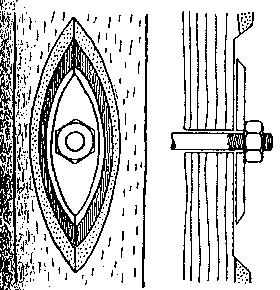
The binding elements are usually steel bars of thickness 10-12 mm passing through the tied pins through and terminated with nuts with large p-shaped washers preventing squeezing into the wood.

The shape of the pad and its arrangement in relation to the pulp plane.

Breaks in branches at forks, part 1

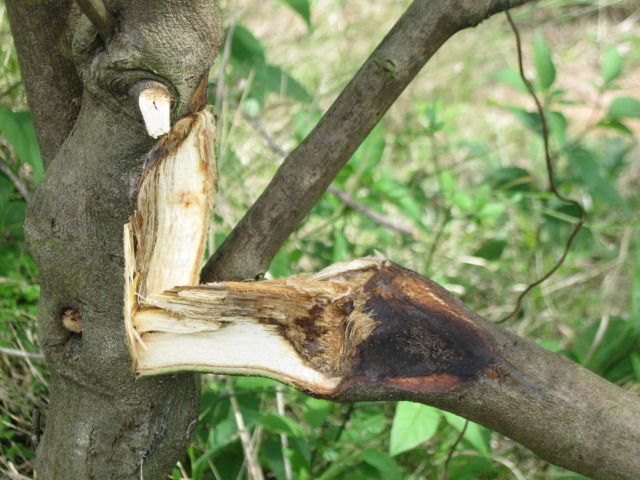
The most common fractures are bifurcations, in which the branches form a small angle with each other. This damage is much more common in older trees, because in such places there are certain stresses caused by the increase in thickness of the forked branches at the point of contact of their surfaces. Stress …