Frost cracks in the tree.
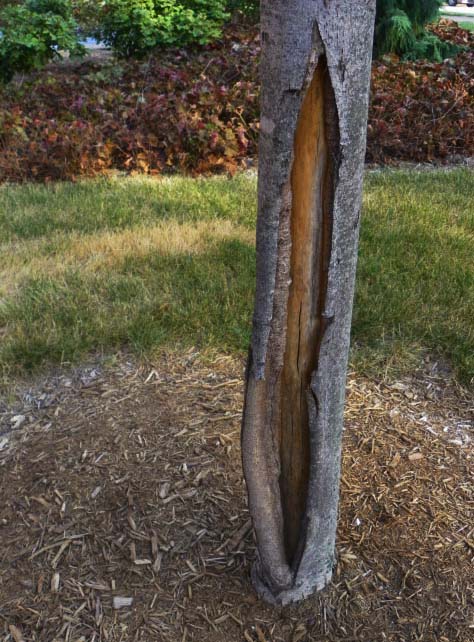 Frost cracks occur as a result of large temperature differences between day and night. During a sunny winter day, the trunk of a tree can get so hot, that it reaches a temperature of a few degrees above zero. As the temperature increases, its volume increases. A sharp drop in temperature at night, down to a dozen or so degrees below zero, causes rapid circumferential contraction of the trunk. The inner wood mass is even warmer and more voluminous, therefore the external mass due to shrinkage may crack along the trunk. The rupture is usually on this side, where the greatest temperature difference occurred, so on the south side. This phenomenon is accompanied by a loud crash ("Biting frosts"). If a similar course of daily temperatures is repeated, the resulting cracks may deepen. The slots thus formed may have a width of up to 2-3 cm depending on the thickness of the trunk and run along its entire length. On the onset of a warmer period, the fractures generally close exactly, a pulp planes touching, forming a healing tissue, they cause their complete growth into the shape of a characteristic scar.
Frost cracks usually do not affect the statics of trees with proportionally extended crowns. However, if the whole tree is tilted or the trunk is loaded on one side, the gaps may spread further and form an open wound., which must be protected against infection by spraying with appropriate agents. Sometimes it may be very advisable to use mechanical methods to approximate distant fracture planes. For this purpose, holes are drilled right through, inserts rods threaded at their ends and twists them.
Trees with high trunks susceptibility to frost cracks include: horse chestnut, ash, elm, clone in the plate.
Preventing frost cracks is quite difficult. The only way to do this is to use covers to prevent the trunk from being heated by the sun's rays. White painting of trunks used in horticulture cannot be recommended, on the other hand, it can be very effective to wrap trunks prone to cracks with various fabrics that hinder heating.