 White poplar (white people)
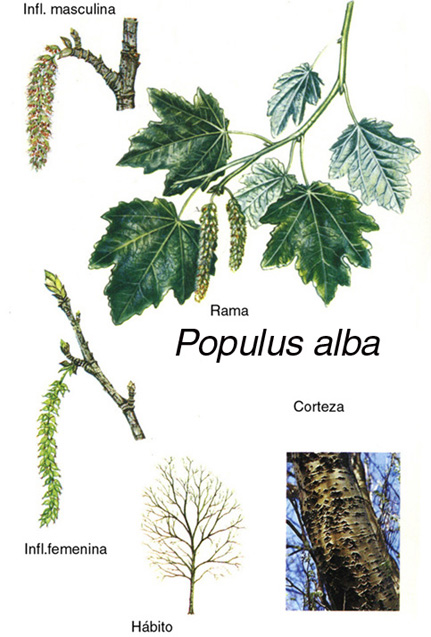
Appearance: A tree that sheds its leaves for winter, with high, often one-sided hanging, quite wide crown, mounted on a strong one, straight or slightly crooked trunk with suckers and roots often growing at the base; height to 30 m, The bark of young specimens is still smooth, whitish gray to greyish green, with age, it becomes more and more rough and darker, as well as cracked and grooved or with lamellar bark, Green shoots, densely hairy white. Small donuts, ovate, brownish yellow. Mouth on long tails in a parallel direction, about the length 6-10 cm and width up to 5 cm, on many twigs also approximately circular in shape, mostly oval and divided into 3-5 larger flaps. Rounded at the base or as if cut at the edges, sometimes short toothed, in the leafing season, woolly or felt-hairy on both sides, later glossy and dark green on top, and white wool on the underside, a bit stiff and leathery. Dioecious species.
Off-white male cats with carmine-red anthers, about the length 4-6 cm are thick, fleshy and hanging down heavily. Female cats are just as long during the flowering season, greenish yellow, even during the fruiting season 10 cm in length. They develop before foliage.
Habitat: The white poplar prefers open ones, moist habitats in loose soils, mainly sandy.
Occurrence. The species is widespread in Europe in riparian forests, riverside or coastal plantations, pioneering stages of the forest.
Flowering period; March to April, General thoughts: The white poplar grows wild almost throughout Europe and is the natural dominant species of the willow-poplar riparian forest along with shrubby and woody willow species.. Thanks to its characteristic two-color leaves, it is undoubtedly one of the most attractive deciduous trees in Poland. However, it is only recently that poplar has been used to fill streets. because its fleece-like leaves can retain a lot of dust and thus contribute to the improvement of air purity in an urban environment. The dust trapped in the layer of hairs is largely washed away in heavy rains and rinsed out with the water outflow yes, that it does not harm the trees, at least in the case of moderate dustiness. Poplar species, same as representatives of the genus Salix (willow), have a clear tendency to create hybrids. Sometimes very strange and unambiguous forms arise. This also applies to the white poplar, as evidenced by the example of the next species.