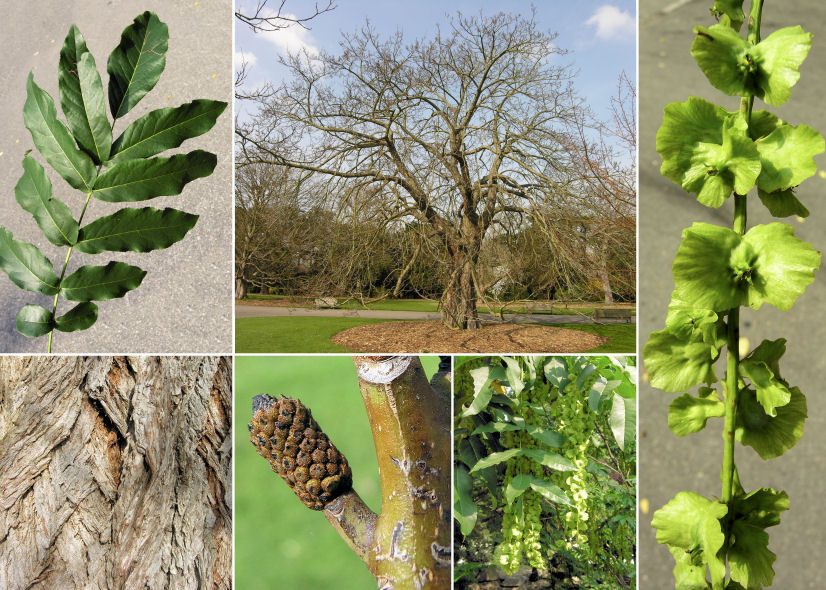
 Ash-leaf walnut (Pterocarya fraxinifolia)
Appearance: A tree that sheds its leaves for winter, about height 15-20 m, with dense, generally strongly vaulted, roundish crown, with one or more trunks.
The trunk is relatively short and branches out low above the ground into numerous thick boughs, rising arched.
Smaller branches and twigs stick out straight or hang slightly.
Gray bark, cracked netting, divided into numerous small fields. Shoots naked, slightly "frosted."”, brownish-green. Donuts delicately hairy, on peduncles, no scales. Odd-feathered mouths, spiral, very big – do 60 cm in length, The leaf axis is rounded, light green or yellowish green, at the root strongly (do 1 cm) swollen. Leaves in 7-20 pairs, have a length 12-18 cm and a width of approx 5 cm. They stand out straight or point slightly forward, briefly sharpened at the top, sawn at the edges, they are set quite densely on the leaf axis and therefore slightly overlap with each other, with very short petioles or almost sessile. The upper side of the leaves is shiny and green, the underside is lighter and dotted, because they are brownish near the medial rib, star-shaped hairs, Mono-tree species.
Thick male flowers, yellow kittens up to 12 centimeters, Slender female flowers, multiflorous, greenish kittens up to 15 cm, which, during fruiting, extend up to approx 50 centimeters.
The light green fruits have a characteristic wide-flanked edge.
Occurrence: The walnut is widespread in the mountain forests of Asia – from the Caucasus to northern Iran. However, this remarkably decorative tree has been around for almost 150 years planted outside their natural range in parks and large gardens, and in places also used to fill streets. The walnut can be planted in Central Europe, because it is frost-resistant and survives the winter, but like other walnut species, it is very sensitive to spring frosts, which can permanently damage the young, emerging leaves, Flowering period: April to May.
General thoughts: The genus Pterocarya is represented collectively by 8 species, whose homeland is Asia, The lamas, however, are divided into two partial ranges: Asia Minor and Southeast Asia. In addition to the walnut tree depicted here, they are sometimes seen as ornamental or park trees, also other species, but Pterocarya fraxinifolta is by far the most widely used, The characteristic samaras of this tree are wide 2-3 cm look like small elephant heads and are eagerly used by DIY enthusiasts. Even in its leafless state, it is easy to recognize – great, light gray to brownish gray, semi-oval leaf scars characterize this species as well. how long, cinnamon-colored peak buds.