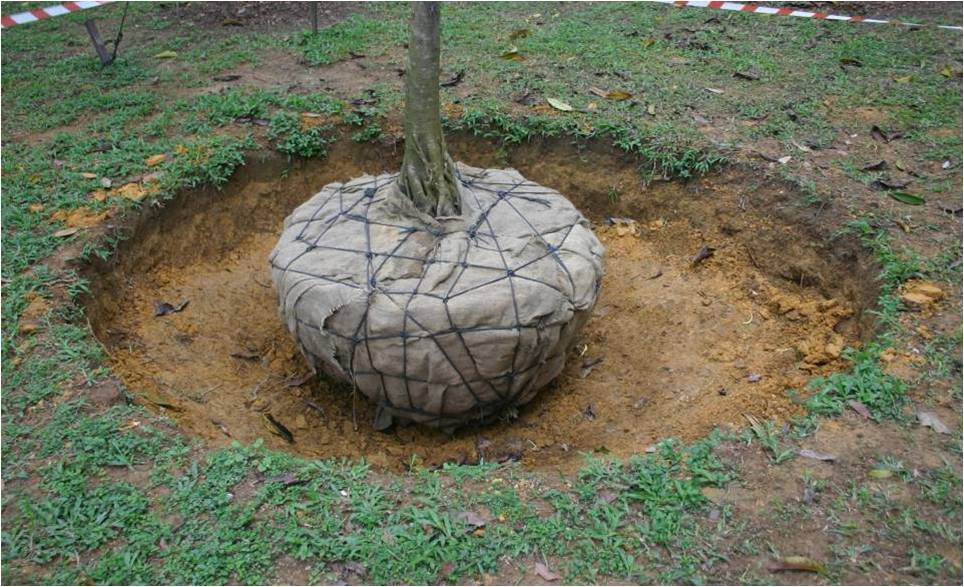
 The development of modern nursery plants allows for the growing use of plants grown in containers (containers), so with a well-rooted lump, which ensures better absorption and significantly extends the planting period.
Planting with a root ball is always used for conifers and evergreen plants. Trees and shrubs that shed their leaves for the period of dormancy are less often planted in this way, unless the plants are planted during the growing season, that is, in a state of foliage or overdoing it in old age. Digging up the above-mentioned plants without a lump deprives them of a significant part of numerous fine roots. As a result, the water supply capacity of the above-ground part is impaired, which loses water through continual transpiration and the plant may dry out as a result. Plants, to be transplanted with a root ball, often preparing for this operation in the nursery by 2-3 lata. This preparation consists in creating conditions for the plant to produce as many small roots as possible in a small lump, easy to remove and transport. Such a body is properly formed and protected against crushing and drying out during transport. Various cheap fabrics are used as security, foil, straw, various types of containers, utensils etc..
If the plants in the containers and their root balls have become very dry during transport (which it should not allow), they should be sprayed a few hours before planting or immersed in water. However, the immersion should not cause the lump to dissolve.
Smaller root ball plants can be planted by one person. The depth of the pits should be carefully measured, in order not to take the plants out for the next measure, because it always causes damage and scattering of the lump. When lifting the plants, always grab the lump or its packaging, and not for a plant. After the plant is formed, the protection of the lump is removed. If it is a jute fabric, paper or straw, that is, materials, which can be decomposed in soil, they can be left for days, pushed off the solid. Pulling the fabric out from under a heavy lump could cause it to crumble, on the other hand, leaving the protective materials at the bottom of the pit provides better air access to the regenerating root system at this point.
The free space between the lump and the walls of the pit is filled with soil suitable for the plant and lightly kneaded or flooded with water. Whipping or trampling should be done carefully, in order not to crush the lump and break the fine roots. The further procedure is the same as when planting plants without a root ball.