Some types of soil with impermeable clay soil or with a high level of groundwater may exhibit excessive moisture at certain times.. Excessive moisture is understood to mean that the voids between soil particles are completely filled, persistent for longer periods. This phenomenon is most often observed in flat arenas during the periods of spring thaw or during unstable rains.. The harmfulness of excessive soil moisture to permanent plants is much greater than in agricultural areas. Hence, it is necessary to secure many places in green areas, including lawns, against excess water.
The easiest way to remove excess rainwater is to drain it off the surface by making appropriate slopes. However, this only protects against the effects of sudden precipitation, when the amount of falling water exceeds the amount of water soaking into the soil at the same time.
A better and more effective way to drain excessively high water is to dig open ditches to the correct depth, into which excess water flows from the soil .
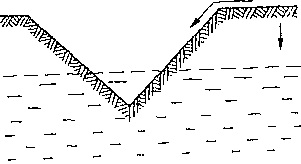 A simple way to drain water through a sewer (a ditch) open.
Such ditches have longitudinal slopes that allow water to drain into the ponds, rivers etc.. In agriculture, ditches are used to drain meadows and fields. They are easy to make, however, they require periodic maintenance, edge mowing, cleaning and dredging, and in addition, they make it difficult to cultivate with mechanized equipment and sometimes they may occupy a significant part of the cultivated area.