The underground ones are much better, covered drainage channels. Such channels are built this way, that at an appropriate depth in a narrow trench, ceramic or other pipes with holes are placed, permitting seepage of water.
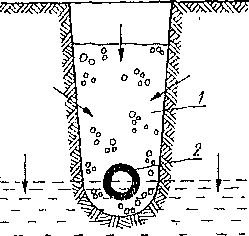 Covered channel draining groundwater: 1 - sand, 2 - a filter.
Pipes are laid with a slope on a bed of sharp-grained sand and the same material is used to fill the ditch up to the height of the arable layer, that is up to approx 30 cm from the soil surface. The cables are laid at intervals of several to several dozen meters, depending on the permeability of the substrate, cable depths, etc.. The length of the cables can be from several dozen to several hundred meters. This way, based on the percolation of water into the filters (drains), is called drainage. Water from the drains is drained into pipes called collectors, through which it flows into watercourses and open reservoirs, i.e. ditches, streams, joints or the like.
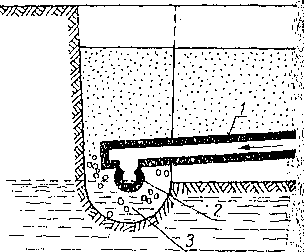 Connection of the filter line with the collector 1 - a filter, 2 - collector, 3 – sand.
In urban conditions, water can be discharged to the general or rainwater sewage system. The distance of the collectors is much greater than that of the filter lines. The lengths of the filter and collector lines depend on the permeability of the soil, flow rates etc.. The drops in the filter lines should not be less than 0,02% and do not exceed the usual 5%.
In areas with large surface drops, the filters and collectors can be placed at a constant depth, in line with the slope of the terrain. However, it is necessary to run the lines of the filter papers at a certain angle to the layer, that is, not perpendicular to the direction of the slope.
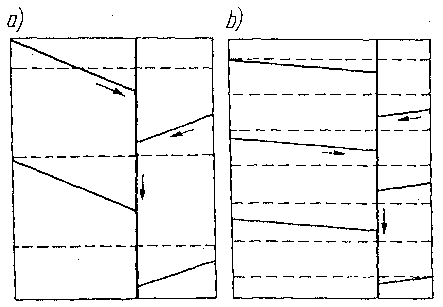 The way of laying the lines of filters and collectors on sloping areas: a0 with a small drop, b) with a large drop.
The greater the slope of the terrain, the more the lines of the filters come closer to the course of the layer, due to necessity| reducing their longitudinal declines. Too large drops in the filter lines may cause leaching by rapidly flowing water of the floating parts of the soil in the vicinity of the filter and destroy the entire drainage system.
On flat, horizontal or slightly sloping terrain, for example, on nearly all grass pitches requiring drainage, however, any system of filters and collectors can be used.
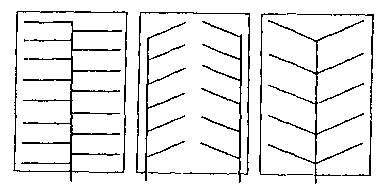 Sample layouts of filter lines and collectors on sports fields.
The filter network is installed after the earthworks are completed, taking over the fertile soil.