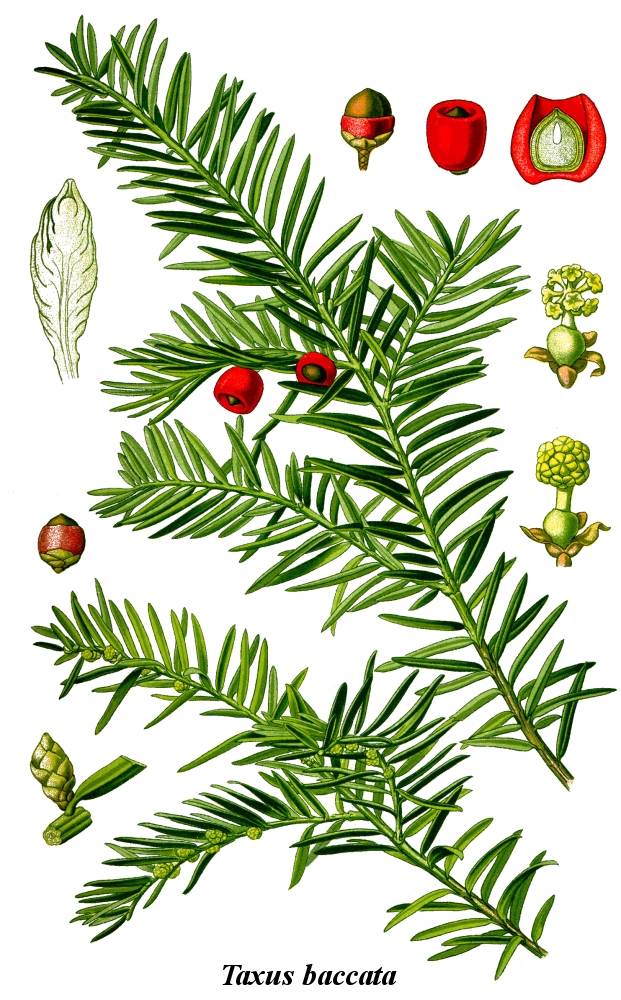
 Common yew (Taxus baccata)
Appearance: Evergreen, dioecious coniferous tree growing up 20 m in height. The crown in specimens with one trunk is wide and tapered either (only in garden forms) columnar, in trees with many trunks – very widely distributed and irregularly multi-peak. Thicker branches stick out or hang slightly, at the ends, however, they tend to rise slightly. Trunks usually covered with smaller branches and twigs.
Brown-gray bark, furrowed and torn into wide fifths or scaly. Annual green or brown-green shoots, with very loose stilettos.
Pins up to 4 cm and width 3 mm are flat, equilibrium. stretched at the front into a slender apex, shiny and dark green from above, from the bottom – clear- or yellowish-green with two distinct, longitudinal stripes, They are arranged in a spiral on the long shoots, apart from that – crest in two rows, always with a center rib.
Male flowers are spherical or oblong, numerous on the lower side of last year's twigs. light yellow or whitish when dusting. The female flowers are rather inconspicuous, Single. The sperm develops fleshy during maturation, carmine red seed coat, called parchment (arillus.
Habitat: Slowly growing yews like shady habitats, on loose, humus and moist soils.
Occurrence. Its single specimens are found throughout Western Europe, it is less common in dense stands. Very often planted in various forms of growth.
Flowering period: February to April. General thoughts: All parts of the plant, except the red seed coat, are highly poisonous,
Related species:
Japanese yew (You are so sharp-pointed) it has very thorny pins and spherical paricle seeds. Chinese yew (Taxus celebica) forms seeds with a greenish seed coat, Both species are planted very rarely.