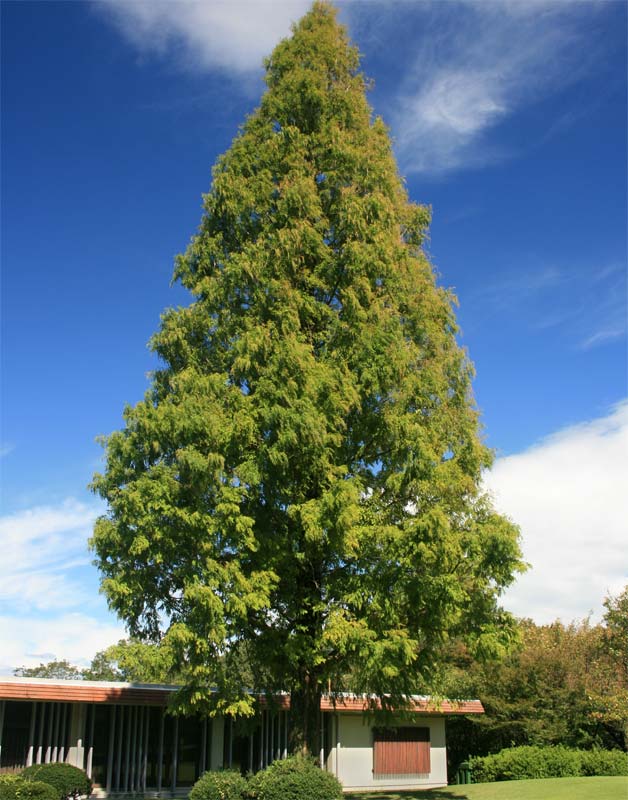
 Chinese Metasequoie (Metasequoia glyptostroboides)
Appearance: A coniferous tree shedding its leaves for the winter, reaches a height of approx 30 meters. The crown of young trees is quite regular conical, with slim, but not a clearly separated peak, seems quite transparent with whorl effect, loose branch arrangement,
Branches stick out horizontally or slightly rise upwards,
The bark is pale brown or slightly yellowish brown, in the lower part of the trunk, it falls off in small longitudinal strands or plates. The trunk below where the branches grow out has peculiar indentations. Light red or pale purple shoots are very thin, delicate and slightly flattened.
Pins set in two rows on opposite shoots, along with which they are shed in the fall. Individual pins in length 1-3 cm are equilibrium, flat, rounded or indistinctly pointed at the front and strikingly soft. They come alive during the foxing season, grass-green color, later they are a bit darker. Depending on the habitat and weather conditions, they turn yellow in autumn, salmon or ruby red.
The male flowers, gathered in large numbers at the base of the leading shoot, are small, spherical.
Female cones on long shafts, spherical or slightly oblong – teardrop-shaped have to 2,5 cm in length, composed of a few very wide cone scales. When ripe, they are light brown in color. Occurrence: The Chinese Metasequoia was not discovered in southwestern China until a year 1941, which caused a little sensation among professionals, During World War II, an expedition was sent from America to collect seeds, however, it was discovered fairly quickly, that the tree can also be easily propagated vegetatively, through seedlings. This method of reproduction is also widely used by gardeners today, because the first specimens planted outside of China only bloomed and produced seeds a few years ago.
Flowering period: April to May.
General thoughts: Chinese Metasequoie, just like ginkgo, it is actually a living fossil, and such, whose fossil ancestors had been discovered earlier, Than a still living representative of this group Fossil leaves similar to metasequoiya are found almost everywhere there, where lignite deposits are mined. Thus, the area of occurrence of this species is still in the Tertiary, or his immediate ancestors, it had to be much more extensive. One can read the major evolutionary age of the entire cypress family from this, that it no longer has a compact range, and its usually monotypic types are found in very different parts of the world in small areas. These trees experienced the period of the greatest development in the Mesozoic era, while the deciduous trees have not yet developed.