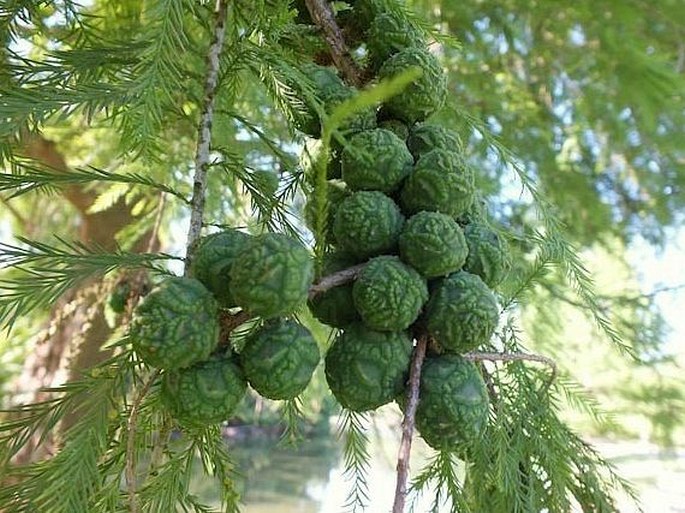
 Mud cypress (Taxodium distichum)
Appearance: Single-stem coniferous tree with shedding leaves for the winter, reaching up to 50 meters. The crown of young trees is narrowly developed, conically, later, more and more round vaulted and almost always rounded at the apex. The trunk is very wide at the base, quickly tapering and straight to the top. Thicker branches, very slightly branched, stick out or hang slightly.
Light reddish brown or pale brown bark, fibrous, comes off with large longitudinal stripes. Annual shoots extremely thin, reddish, are covered with leaves late.
Pins on long shoots arranged in a spiral. Single-standing short shoots are approx 10 cm in length. Pins double row length up to 2 cm are equilibrium, flat, with delicate longitudinal stripes on the bottom, arranged individually. At the beginning the foliage comes alive, light green color, they darken later, Pins are shed in the fall along with the shoots.
Male flowers numerous at the ends of last year's twigs (long shoots), yellowish or purple.
Female cones, about the length 1-3 cm, kulisie or slightly oblong in the shape of a drop, they consist of a few scales.
Occurrence: The marsh cypress comes from the south-eastern regions of North America (Florida, is Mississippi), however, it has been planted for a long time in Europe as a park and ornamental tree.
Flowering period: April to May.
General thoughts: Under natural conditions, this tree inhabits humid lowlands with a high level of groundwater, or flooded periodically or permanently. Under such conditions, it often happens, that the root system may not be sufficiently oxygenated. In order to nevertheless supply the root layer with sufficient oxygen, the marsh cypress has developed a special organ: peculiar, do 40 cm high, "Breathing knees”, which grow underground surrounded by a tree in the form of stump-like outgrowths and finally pierce the surface of the ground. Through the loose tissue of this particular "device."” Atmospheric oxygen can now be supplied all the way to the deepest parts of the roots. This peculiarity can often be seen also in planted park trees – naturally provided, that they were planted near water reservoirs and that they are old enough. Even in the Tertiary, the marsh cypress trees were widely spread all over the Earth. In numbers of approx 20 million years of clay layers, lignite deposits in the Rhineland, there are fossils of leaves almost the same as the leaves of modern marsh cypress trees. These trees belonged, at least periodically, to the most important "producers” lignite in Europe.