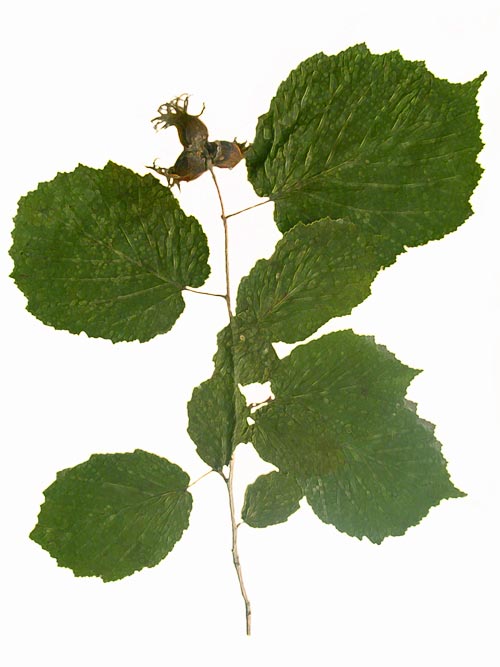
 Turkish Hazel, tree hazel (Corylus colurna)
Appearance: The smaller tree with the highest height 20 m, rarely – higher. The crown is usually wide conical or ovoid, with slim, well-marked vertex, regular and homogeneous in outline. Branches and branches, at least in younger specimens, almost whorls, but always inclined upwards and quite straight. Blades are brownish, gray-white, and sometimes also reddish, strongly furrowed and cracked, quite rough, cork, even on younger specimens it is scaly and larger, roundish lobes. Shoots densely, glandularly hairy. Smooth donuts, adherent, ovate, greenish-brown. Torsion leaves, short tail, length 8-12 cm and almost the same width; the widest in the central part of the lamina, and heart-shaped at the base, Shortly pointed at the front, and at the edges are double toothed or slightly rebated, quite stout and heavy when developed, that is why they are so characteristically pendulous. Shiny on the outside, green, matte underneath and a bit lighter. Male cats in length 8-12 cm. naked, green in a winter aspect, later brownish, and in the flowering season it is light yellow dusty. Female flowers in the form of a bud, during flowering recognizable only by long ones, protruding, usually carmine-red birthmarks. The leafy cover around the nut is much larger than that of the closely related shrub common hazel (Corylus a ve liana), very deeply divided into numerous sections and plots, densely hairy on all sides, sticky, ordinary light greenish-yellow, and when ripe, brown-gray. A walnut similar to a hazelnut, but a bit bigger (do 2 cm in length) and with a much thicker shell, brown when ripe, it is very difficult to break free from the fruit cover. Edible kernel and, just like the hazelnut, very tasty. Occurrence: Widespread in the mountain forests of Southern Europe and Asia Minor. Flowering period: March to April. Related species:
Chinese hazel (Corylus chinensis) in its homeland it reaches almost heights 40 meters. Its leaves about a length 10-16 cm, are unevenly heart-shaped at the base, they have evenly, individually serrated edges, on top they are naked, and underneath, on the larger veins. Leafy fruit cover becomes tubular in shape. The walnut is edible. Recently, more and more often planted as an ornamental tree. The native common hazel and the native of Southern Europe Turkish hazel form a hybrid species known as Corylus x colurnoides.
Rods, mainly from common hazel, growing out as a sucker after it has been cut, have long been used in the manufacture of braids, baskets or as a covering for roofs in peasant huts, field sheds, and also when putting up fences. Flexible hazel rods do not have any economic significance today. In villages they are still used in gardens as supports for plants and bean sticks.