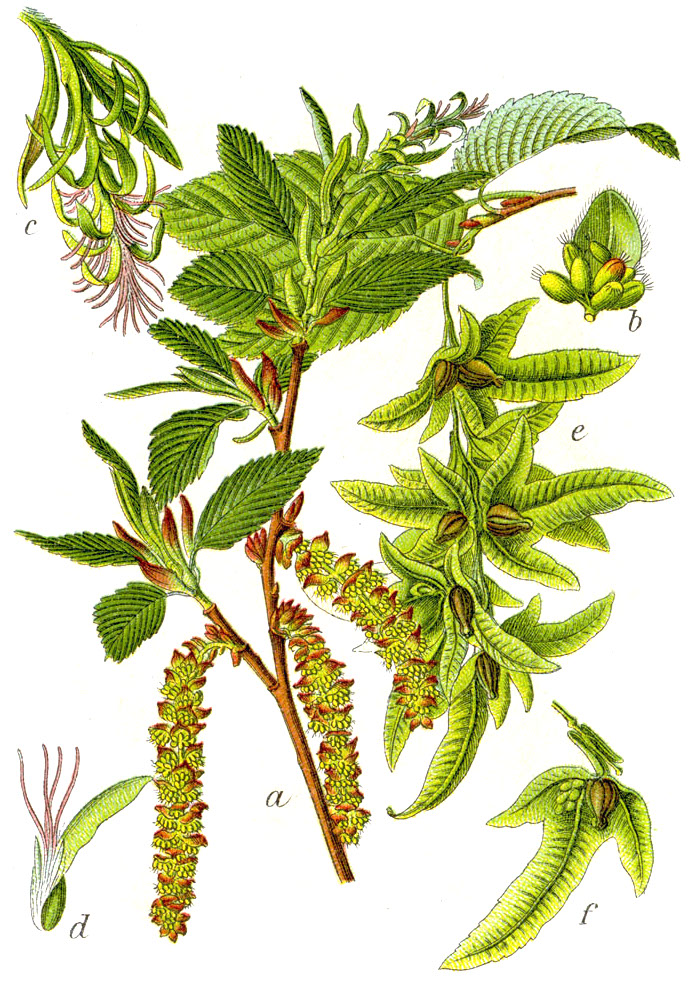
 Common hornbeam (Birch wood)
Appearance: A sizeable deciduous tree with a wide and high crown, often somewhat irregular, beautifully vaulted, especially in free-standing specimens. The height usually does not exceed 20 m, in the Białowieża Primeval Forest, however, adolescent specimens are known 30 meters.
The trunk is rarely evenly round, mostly oval in cross section, especially in older trees – twisted or hunched over, usually it is divided into thicker branches at a slight height.
Bark clear- or dark gray, initially smooth, later with a delicate mesh pattern or covered with flat slats. Steeply upright boughs, a bit bent. Dark gray-brown shoots, with sparse hair. Very slender donuts, fit tightly to the axis.
Torsion leaves, oblong ovate, about the length 4-10 cm. briefly pointed at the front, rounded at the base, usually somewhat asymmetrical. The edges of the leaves sharply, double and very finely serrated. Both sides shiny, with this, that the top is clearly more vivid green. The petiole has about 1 cm in length. In autumn the leaves change to a beautiful bright yellow color. Mono-tree species.
Male cats have 3-5 cm in length. Female inflorescences with characteristic triplets during fruiting, pale green pituitary glands, covering little peanuts. Habitat: Important forest tree growing in the fresh, fertile, humus soils. Creates tree stands in deciduous forests with undergrowth rich in herbs or in mid-field tree stands and shrubs,
Occurrence: Widespread and common throughout Europe – from the Pyrenees to southern Scandinavia, and in the east as far as Turkey; often also planted.
General thoughts: Grab – unlike other deciduous trees – it is especially readily used in mixed forestry because of its resistance to pruning and logging. In many areas of its natural occurrence it has completely disappeared, because in the past, suitable for my habitat, they were particularly eagerly converted into agricultural land. A peculiar three-lobed cover of hornbeam fruit, it is used in spring and summer for photosynthesis, and thus to nourish the ripening seeds; later it changes function and becomes a volatile organ. Winter storms can carry seeds even over distances 1 kilometers.
A related species:
Eastern hornbeam (Eastern hornbeam) is a shrub or a smaller tree up to about 10 meters. He has a small one (4-6 cm in length) ovate or oval leaves with very dense lateral veins, double on the edge, sharply serrated. Quite common in the mountains of the Balkans and Asia Minor: in the west, it is found all the way to southern Italy and Sicily. Rarely planted.
Hornbeam wood is very resistant and hard. Formerly it was used for making mill wheels, today it is used to make tool shafts,