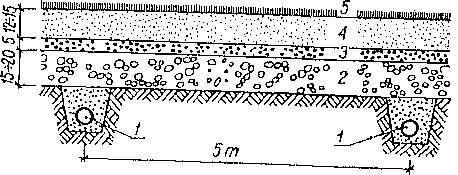
 Drainage is performed in the following sequence. The whole area is very carefully leveled on the horizontal plane located o 27-35 cm below the design lawn soil height. A layer of fine gravel is not included in the thickness, because it will fill in the unevenness of the fine gravel layer. Then, the lines of the filters are marked and the depth of the grooves is determined, taking into account the slopes. The filters are placed on a thin layer of river sand with homogeneous graining and covered with this sand to the level of a leveled trench. The soil from the filter pits should be loosened. Then spread the fine gravel layer, checking its thickness, and then a layer of gravel. In the event of using crushed stone instead of gravel, it is necessary to roll the entire layer with a light roller. After the gravel layer is leveled, the soil is decomposed, where it should be 60% sand, 20% fertile land and 20% slightly composted (wet) peat. On this layer, after careful alignment, you can sow grass seeds or lay turf.
Various ways of using a drainage system to irrigate the soil during periods of drought have been used for a long time. The use of db for this purpose of a typical network of filters and collectors is not possible due to the slopes, quality of filter connection, their surroundings, etc.. In such systems, water would have to be introduced under pressure from the lowest points. Number of losses, that is, water not used by plants, it would be very large because it soaks mainly into deeper layers. Thus, the use of a network of drainage pipes for irrigation is faced with many difficulties, which are not easy to solve.