The Institute of Municipal Economy has developed the composition of grass mixtures using Polish varieties. Here are some examples:
1. Universal mixture for park and garden lawns (carpet) on loamy-sandy soils:
The ryegrass persisted (Perennial lily) Wiecławicka 20%
Red fescue (fescue rubra) Leo 40%
Meadow grass (Poa pratensis) Alice 40%
2. A mixture for garden and park lawns on dry soils:
The ryegrass persisted (Perennial lily) Wiecławicka 30%
Variegated fescue (Fescue heterophylla) Okay 40%
Velvet (You are thin) It is 30%
3. Mixture for sports lawns on good soils or suitable substrate:
Meadow grass (Poa pratensis) Alice 25%
Red fescue (fescue rubra) Leo 20%
Variegated fescue (Fescue heterophylla) Okay 25%
Velvet (Agrostis thin) It is 30%
The percentage of each species of grass in the mixtures presented relates to the weight of the seeds. The proportion of the number of seeds in the mixture does not correspond to the proportion by weight, because the seeds of different species of grass differ in size and weight.
When determining the number of seeds per unit area, it is assumed, that there should be an area per seed 1 cm². The relationship between the weight of seeds and their number in 1 gram and the theoretical sowing standard per unit area are given in the table.
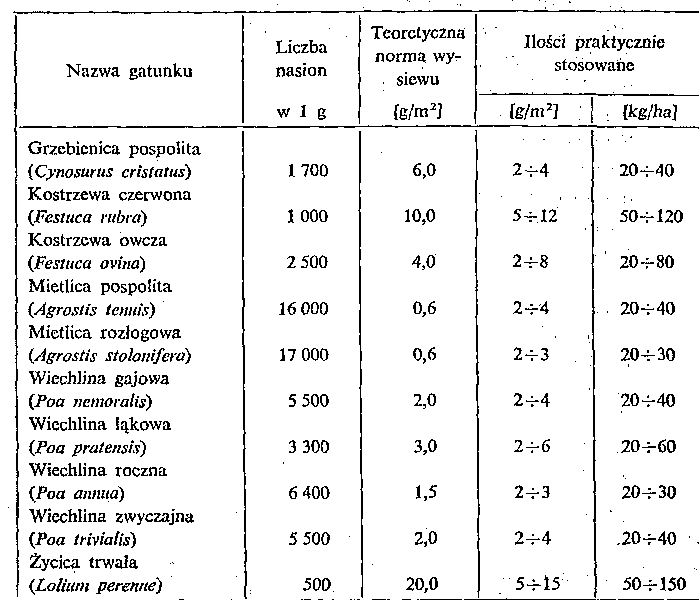
The table shows, that depending on the size and weight of the seeds, the theoretical sowing rate of the mentioned grasses may vary from 0,6 do 20,0 grams per 1 m². For grasses with larger and stronger seeds, like for example. ryegrass was sustained, in practice, much smaller amounts of seeds per unit area are used. On the other hand, the seeds of small grasses, so about less possibilities of quickly mastering the place, it is practically sown in an amount usually several times higher than the norm. The seed quantity for sowing can be changed depending on the sowing time, how the seeds are covered, anticipated germination conditions, etc..