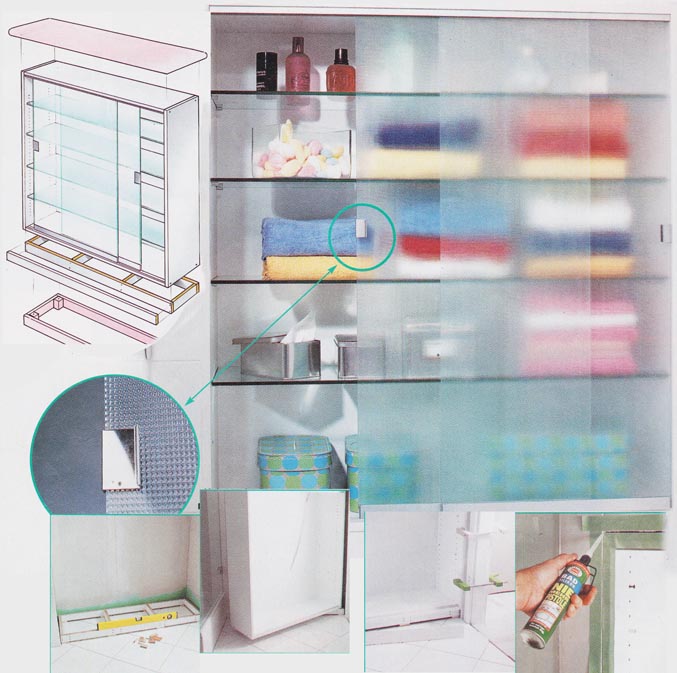
 The unused wall recesses are the space given to us by "fate", which can be turned into a practical wall cupboard with little effort. Everything, what we need is some chipboard, a few panes, fittings that allow them to be moved and some time.
Recesses are found in most houses, both in the old, as well as in new construction. A self-built built-in wardrobe is a great way, to avoid turning them into a messy repository of all kinds of items.
For the side parts, shelves, cover elements and rear panels, you will need five coated particle boards with a thickness 19 mm. The dimensions of the boards depend on the dimensions of the recess. Two rows of holes should be drilled in the side walls, in space 6 cm from the edge. They are used to fasten the shelf supports. Individual parts are screwed together and connected with lacquer glue.
Trimming the glass for the door (of thickness 5-8 mm) and insertable shelves (6 mm) we outsource to the glazier, and we can grind their edges ourselves. Thanks to mounting in special profiles, glass panes will turn into easy-moving sliding doors.
This type of construction allows us to build a wardrobe in two variants: recessed and free-standing. The first has already been described. Other, marked in red, it has a veneered plinth and an additional top plate bolted to the underside. The sides of the free-standing plinth are glued from the inside with short stiffening elements cut from square timber, and then tightens with the screws.
Glass doors will slide easily, if they are mounted in special profiled rails. The edges of the glass must be ground, that they do not risk cutting their hands. A guide with a height 6 mm sticks to the bottom of the cabinet. The rubber profile holds the glass in a trolley with rollers equipped with ball bearings (two trolleys will hold a weighing door 25 kg, four – 50 kg). The top edge of the glass door slides in the guide profile screwed to the cover of the wardrobe.
You can purchase the glass slide holder at a DIY store. It is made in the shape of the letter U, which makes it possible to put it on a glass pane and fix it with a self-adhesive rubber pad.
Structural glass sliding doors are elegant and transparent. So it's easy to recognize things inside and just as easy to take them out.
The cabinet plinth consisting of strips of chipboard twisted together should be leveled with wooden pads, for the wardrobe to stand straight in the recess.
The dimensions of the recess above the plinth determine the size of the cabinet body. It is mounted from chipboard with screws and wood glue, and then slides it into the recess.
The embedded body is fixed in the recess with screw clamps, in order to fit it to the plinth, also made of strips of chipboard.
The gaps are filled with silicone mass intended for wet rooms, because it contains additives to prevent the growth of mold.
Four screws connecting each side of the cabinet with the wall protect it from falling out of the recess. We mark the places of the holes and drill after removing the wardrobe.
LACQUER VARNISH is a special agent for bonding coated or varnished wood to boards.
PERFORATED RAIL is a device that helps to make rows of holes at regular intervals. It allows you to drill with very high precision with minimum effort.