Ways of securing the root ball.
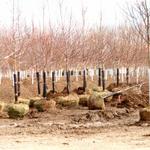 The root ball of transplanted trees is almost always exposed to crushing during transport operations. Only lumps very strongly overgrown with roots and formed from compact soils, np. clayey, they handle transport quite well. Therefore, it is necessary to use appropriate safeguards, to prevent damage to the block during transport. Such protection is not only a mechanical protection, but often also protection against water loss. Drying out the lump may cause the roots to die, and moreover, it may facilitate the breaking of the lump, if it is formed from looser soil, np. sandy loam.
The easiest way to prevent lumps from crumbling is to freeze them. The lump of a tree intended for such transplanting is formed during not very severe frosts, but the ground around the tree must be adequately protected against freezing. For this, a layer of approx 20 cm of peat, leaves, of straw or the like on an area of at least twice the diameter of the projected body. Planting sites should be similarly secured. Pits can be prepared in advance, before the onset of frosts, however, they require frost protection. Planting trees in deeply frozen pits may expose them to a long-term lack of water due to the inhibition of soaking.
Remember to prepare and protect against freezing of sufficiently fertile soil to fill the space between the mass and the walls of the pit. Once the body is formed and frozen, it must not be exposed to prolonged exposure to low temperatures, especially below - 10 ° C. If the tree cannot be replanted immediately, the lump should be covered, not so much though, to dream.
The described method of transplanting has the following advantages:
— spośród wszystkich stosowanych sposobów wymaga najmniejszej nakładu robocizny;
— umożliwia przesadzanie w okresie, when there are few other jobs;
— umożliwia formowanie bryły o dowolnym kształcie;
— nie wymaga innych sposobów zabezpieczenia przed rozkrusze-niem;
— umożliwia dojazd ciężkimi pojazdami w każde miejsce bez niszczenia powierzchni trawników itp.;
— jeśli odległość transportu jest niewielka — umożliwia przesuwanie drzew na płozach po śniegu.