Another way to secure the solid is wrapping with elastic materials and lacing. This method is the most widespread in almost the whole world. The described security feature requires the formation of a very rounded body. Due to the rounding of the body, the compressive forces resulting from lacing are distributed evenly and do not cause stresses, which could cause the lump to break or crush during transportation.
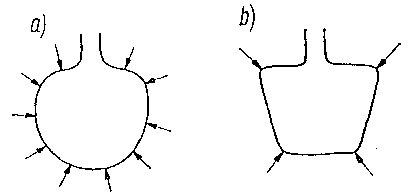 Solid shape secured by wrapping and lacing: a) appropriate, b) wrong.
The protected block should be excavated in width 30-40 cm to access its surface. The trench should reach the bottom of the solid not deeper than to the bottom 1/4 diameter. Deeper undermining may result in subsidence and destruction of the block. A jute fabric is placed on the suitably formed surface of the body, paper or foil. Arrangement 2 the 3 layers increases the flexibility of the protection. The foil can be secured against slipping during application by inserting 5 cm nails. A loop with a diameter of approx 1/2 the diameter of the body. The cord used for this purpose should be of good quality and thick 5-8 mm. After the loop is in place, the proper lacing is made by passing the rope through the top of the lump and the loop. To secure larger blocks, a loop is also used in the upper part.
After the lacing is put on, the cords are tightened in the order they are passed. The whole process of lacing should be performed by two people. The cords should be tensioned gradually and this operation is usually repeated twice until sufficient tension is obtained.. Instead of putting a rope through a loop, which takes a long time, thick wire hooks can be used, which connect the string with the loop. This method greatly speeds up the lacing and its removal.
The advantages of the described method of securing are as follows:
— the greatest certainty of not crushing the lump;
— the ability to adjust the proportions and dimensions of the block to the condition of the root system;
— good protection of the body against drying out, and even allowing it to be watered while it is waiting for transport.