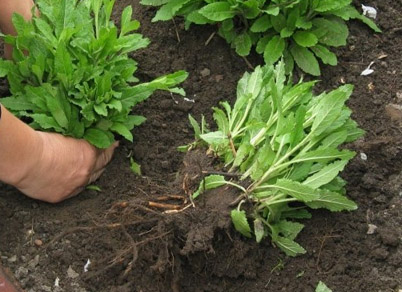
 Propagation by cuttings is a bit more difficult, however, it can be successfully used for many species of perennials. Herbaceous cuttings are parts of non-lignified shoots from 3…4 well-developed buds. They are cut in spring before flowering, and in species, which bloom in the spring, np.: floksa szydlastego, lavender, the cornea, only after fading or in September. If the plant stem is empty inside, it is not cut, but he tears off yes, so that a piece of the old stem remains at the base. This is true for lupine, delphiniums, sage, hearts and adjective. The length of the seedling should not exceed 10 cm. When it is longer, its rooting ability is significantly reduced. The best rooting medium is a mixture of equal parts of peat and sand, you can also mix light garden soil with peat. Some species, np. stonecrop, they take root so easily, that you can place seedlings directly in the ground. At the time of rooting, it is preferable to sprinkle and shade the cuttings.
Root cuttings are formed by cutting the roots into 2 lengths…5 cm, each of which has at least one bud. The mother plant is dug up from the ground in autumn and stored frost-free over the winter. In spring, cuttings are rooted in the same way as herbaceous cuttings, in the inspection or in the apartment, w temp. 10…15°C. This is how phlox reproduces, alpine aster, Carpathian bell, hearts, lupine, eastern poppy, Japanese anemone (garden anemone), mountain cornflower, sasanka, adjective, nineteen.