In the process of preparation, only the roots are cut through the side walls of the lump. The roots that pass through the bottom of the lump remain uncut until transplanted. During preparation, they play the role of securing the tree against unfavorable weather conditions, and most of all, lack of rainfall and neglect of watering the tree. These roots, although to a small extent, they protect the tree against deviating from the vertical. Trees with an extremely shallow root system should be tied to pegs driven next to them or secured in a similar manner. Trees growing in places exposed to strong winds should be tied regardless of the type of root system.
If the preparation of the tree is to be carried out very carefully, that is, good conditions are created for the formation of a large number of young roots, the size of the body can be reduced by 20-30%. A tree with such a lump is easier to transport to a new place, trees can therefore be transplanted in this way, which could not be transported with a normal lump. However, one must remember, that too short pruning of thick roots in some softwood trees, like for example. linden trees, can infect the wood extending to the trunk.
The technique for preparing a tree for replanting is discussed below.
After determining the diameter and height of the lump and determining its circumference by cutting off an appropriate groove, the surface layer of soil is removed until it meets the first roots. Then on the inside of the designated area, perimeter you dig a groove with a width such as a shovel, i.e. approx 25 cm and a depth equal to the thickness of the solid. The groove is slightly sloped under the solid.
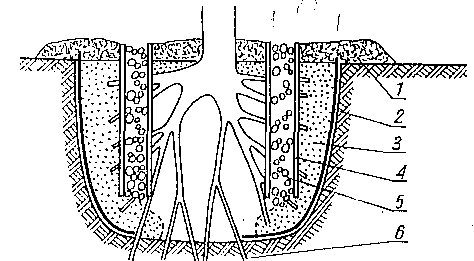 Cross-section of a root ball prepared for regeneration:
1 - peat litter, 3 — folia, 3 - peat substrate, 4 - ceramic filter, S - aggregate, 6 - hedging roots.
The encountered roots are removed across the width of the groove, cutting them off with sharp tools first from the solid side, and then at the outer wall. If the parting is to be done in two or more steps, a suitable part of the thicker roots should be left untrimmed. If it is possible, choose the shallowest roots. It is necessary to make a sketch of their location and cutting schedule for this purpose.
The cut surfaces should be as small as possible (perpendicular to the length of the roots) and smooth. If the soil in the lump is not overgrown with roots, it can be crushed and removed. Then the walls of the trench are covered with polyethylene foil with a thickness of approx 0,1 mm, which is designed to prevent the roots from growing beyond its plane. This plane is the outer surface of the solid. The foil is also responsible for maintaining the appropriate humidity inside the body. Then the free space is filled with peat compost rich in easily digestible nutrients or with soil with a high humus content.. This material should not be compacted, and just knead it a little, so as not to obstruct the access of air to the forming roots.