By transplanting trees with lumps of size determined by the thickness of their trunk, depending on the age of the tree, cuts off 60-95% the roots. The older the tree, the farther from the trunk it has the finest and most numerous roots for water and nutrients. In most trees growing under normal conditions, they are located at a distance from the trunk that corresponds approximately to the extent of the crown. This remoteness of the roots causes, that as a tree ages and grows in size, transplanting involves the loss of more and more of these roots. As the tree grows, the chance of maintaining the necessary physiological balance between the underground and the aboveground parts decreases, hence, the likelihood of a successful tree replanting is less and less likely.
Large trees could be transplanted without risk of failing, if each tree front, transplanting, could create a root system in a small body with full physiological efficiency in relation to its crown. Such a possibility exists and consists in gradual cutting of the roots, and at the same time creating conditions for their reproduction in a mass of a much smaller volume. The treatment for this purpose is the essence of preparing the tree for replanting. The tree can be considered prepared, once its severed root system has been regenerated to the point of acceptance and continued successful growth.
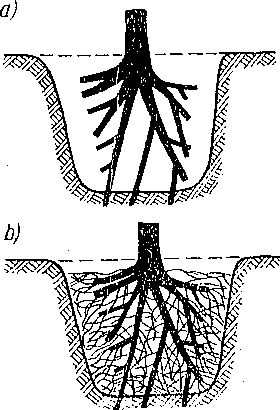 Preparing the tree for transplanting: a) tree after cutting its roots, b) a tree with a root system regenerated in a lump of a volume that can be transferred.
If preparation is to take place in one growing season, either all the roots are cut in the spring, or one part in the fall, and the other in the spring. Larger trees need to be prepared for at least two seasons. The roots can then be cut in two stages in spring or in four stages - twice in spring and autumn.