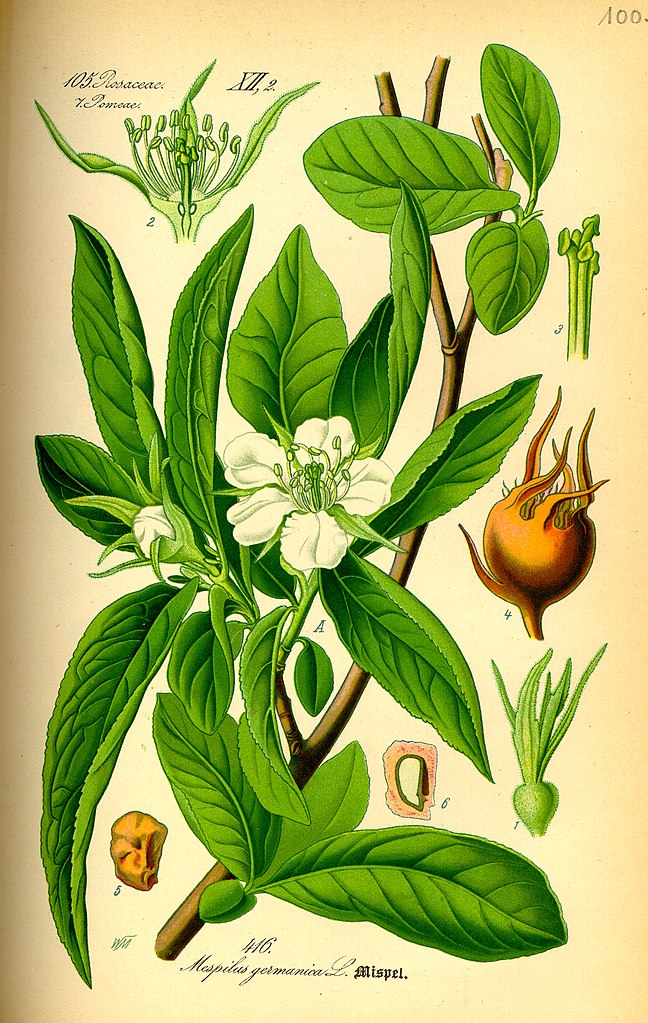
 Medlar (Mespilus germanica)
Appearance: A tree that sheds its leaves for winter, reaching 4-6 m in height, sometimes even up to 10 meters. Crown usually very wide and low, with few, very thick, me-significantly rising branches. The tree often has many trunks.
Bark initially smooth and gray-brown, in older specimens, it deeply cracks and falls off with longitudinal, rectangular lobes. Strong shoots are initially densely pubescent white, which makes them seem a bit felty.
Torsion leaves, almost tailless and sedentary have 5-12 cm in length and 2-4 cm wide, Oblong-oval or elliptical to inversely ovoid, very briefly sharpened, rounded at the base, full or slightly serrated edge, slightly wrinkled by strongly recessed nerves. Matt on the outside, dark green, and underneath it is white, felt hairy.
Flowers with strongly felt sepals and pure white petals grow singly, rarely for two, on very short stalks. When they are open, they have approx 6 cm in diameter. Numerous stamens, with dark red anthers.
Long fruit 2-3 cm, it has a pear-shaped spherical shape and draws attention with five permanent sepals, coming together in the form of a crown. Initially indistinct brownish green, later brown; edible only after freezing, Occurrence: Medlar comes from Southeastern Europe and is quite common in the wild, primarily in the Black Sea area. In the rest of Europe, this tree is still eagerly planted today because of its peculiar fruits.
Flowering period: Maj.
General thoughts: Latin name (germanica = German) of this species, formerly regarded as "wild fruit”, it is completely inaccurate and misleading, because it is in fact an East European and West Asian tree.
Due to the interesting shape of the fruit, medlar should be considered more often when selecting species of woody plants in parks and gardens.