 Japanese larch (Larch kaempferi)
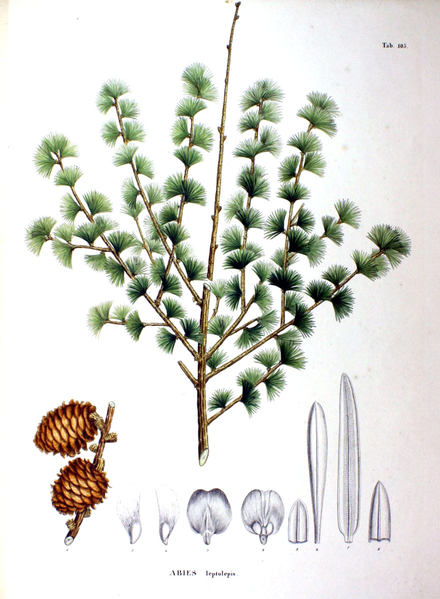
Appearance: A coniferous tree shedding its leaves for the winter, reaches a height of approx 40 meters. It has a wide, conical crown, which does not keep such a slim shape, as in the previously described species. Leading shoots do not droop.
The lower branches are very branchy and at the tips rising upwards again. Middle branches spread wide.
Reddish brown bark, scaly r sometimes falling off with small oblong petals. Young shoots and twigs are clearly darker. than the European larch, usually dark orange-red to brownish or brownish-purple and dusted with gray; thanks to this, even in the winter coat they are usually clearly distinguishable from the European larch. The buds are pointed and conical on the shoots, exuding resin. Relatively soft heels, pointed or slightly dull, blue-green on top (never grass green), underneath with two white stripes of stomata. They are approx 2-3 cm and grow in large numbers when collected (after 30-40) on shoots.
Female cones numerous in the upper sections of larger branches, initially bright red or yellowish, later green or dark yellow, and in the season of ripening – brown, height and width approx 3 cm, rosette-shaped and flatter than European larch, The scales of the cones at the edges are clearly turned outwards.
Occurrence: Originally, this species of larch was found only in Japan. It has been planted in forests on a large scale for a long time, because it grows much better than its European relatives. Flowering period: March General remarks: Japanese larch is much less sensitive to industrial gaseous pollutants than European species and is therefore increasingly planted in city parks. According to the current state of knowledge, Larches also seem to be slightly more resistant to acid rain than other domestic and domestic coniferous trees. What it comes from – yet it is not known. That's possible, that the lower sensitivity to harmful substances is only due to the presence of a layer of wax on the pins. Besides, larches shed their pins every time at the end of the growing season, Thus, the collected harmful substances are not accumulated so intensely in the flesh of the tree, as is the case in species with perennial pins.
Larch wood is considered a particularly durable material. The outer white is very light at first, however, it gradually darkens. The heartwood is dark brown when fresh. Wood is used in the construction of houses and ships, Due to its durability, it is mainly made of sides and paneling.