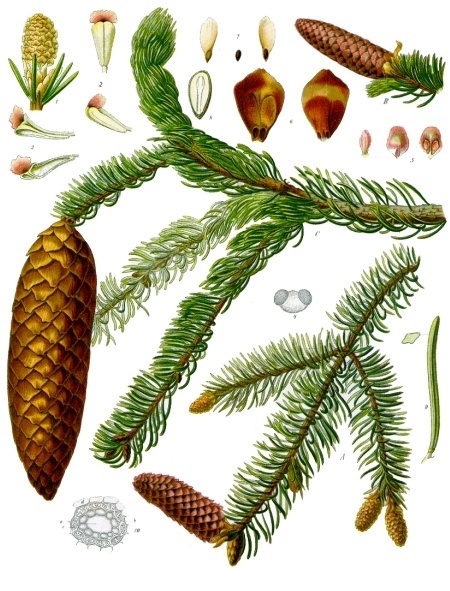
 Norway spruce – Picea abies (L.)
Characteristics: Evergreen coniferous tree up to 70 m (most often 30-50 m), making it the tallest native tree in Europe. In the Białowieża Primeval Forest, the tallest spruce is tall 55 m and trunk diameter 140 cm, and his age is over 300 lat. Crown, especially in free-standing trees, it has the shape of a very regular cone.
Branches arranged in a whorl, at the bottom of the trunk they hang down, in the middle of the trunk, however, they usually stand out straight or rise slightly.
Kora – the color of the copper is delicately flaky. Young shoots reddish, slightly hairy or naked, dull and quite thick. Dark donuts, oval, a bit tightened.
Length pins 1-2,5 cm are quite stiff, pointed at the ends, dark green, diamond-shaped or quadrate-shaped in cross-section. Arranged around and mostly facing the front, There is a delicate lighter line on the top and bottom.
Male carmine red flowers. Female cones – oblong, usually in large numbers in the upper parts of the crown. Young cones are green and mature, with scales with smooth edges, light brown and have 12-16 cm in length, Habitat: The roots of the spruce are shallow in loose, humus soils that freeze in winter. It produces butvine and therefore causes soil acidification in monocultures, it is therefore very difficult to replant this area with deciduous trees. Occurrence: Originally from Scandinavia to the Balkans in the areas above 800 m n.p.m. as a forest-forming species. As a result of planting in forest crops, it is now everywhere at home.
Flowering period: From April to May Related species:
Sitka spruce (Picea sitchensis} it is distinguished by thick annual shoots, usually facing up. Studs sticking out, flattened, with a distinct keel, bright green, a bit shiny, with prickly ends. His homeland is the western coastal areas of North America from central Alaska to California. Sometimes it is used in forest cultivation.