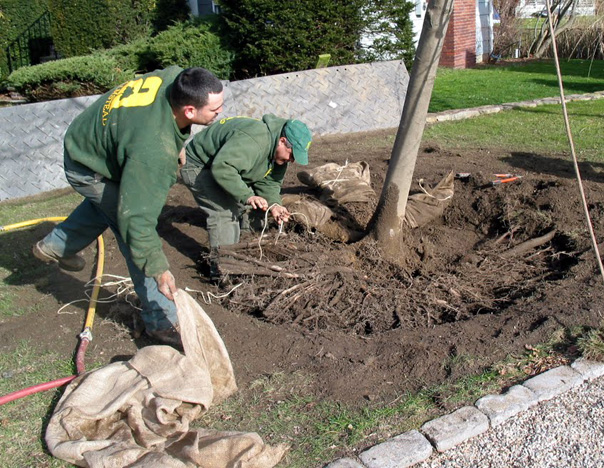
 The tree is usually removed from the vehicle by a crane at the planting site. If the block is well secured and has a small size, the tree can be pulled off after, a ramp made of planks.
The depth of the pits for planted trees should correspond to the height of their root ball, and the width should allow free positioning of the solid and its unwinding. At the bottom of the pit should be 10-20 cm of fertile soil in a loosened state. This layer facilitates the contact of the root ball with the local soil.
After setting the solids, it is removed , its security, and then covers half the depth with earth and tramples it. After adding the rest of the soil, it is good to pour water over it in an amount that allows it to be saturated to a depth 20-30 cm. Then you sprinkle soil and form a bowl around the tree. The surface of the bowl is covered with a 10 cm layer of peat mulch or similar material.
In order to protect the planted tree from being knocked over by the winds, it should be tied to the trees planted next to it 3-5 pins. Trees planted in the streets, which cannot be tied to pegs due to foot traffic, is secured by tying the solid with galvanized steel wire to two round logs buried below the bottom of the pit; from the top, the solid is covered with boards, the wire is run across it. After 2-3 Over the years, the wires are cut and boards are taken out, if they have not completely decomposed.
The described methods of transplanting large trees suffer from a number of disadvantages, which cause, that these operations are not only technically difficult but also costly. Hardware work is very expensive, which includes commuting and returning, and labor constituting 40% costs.