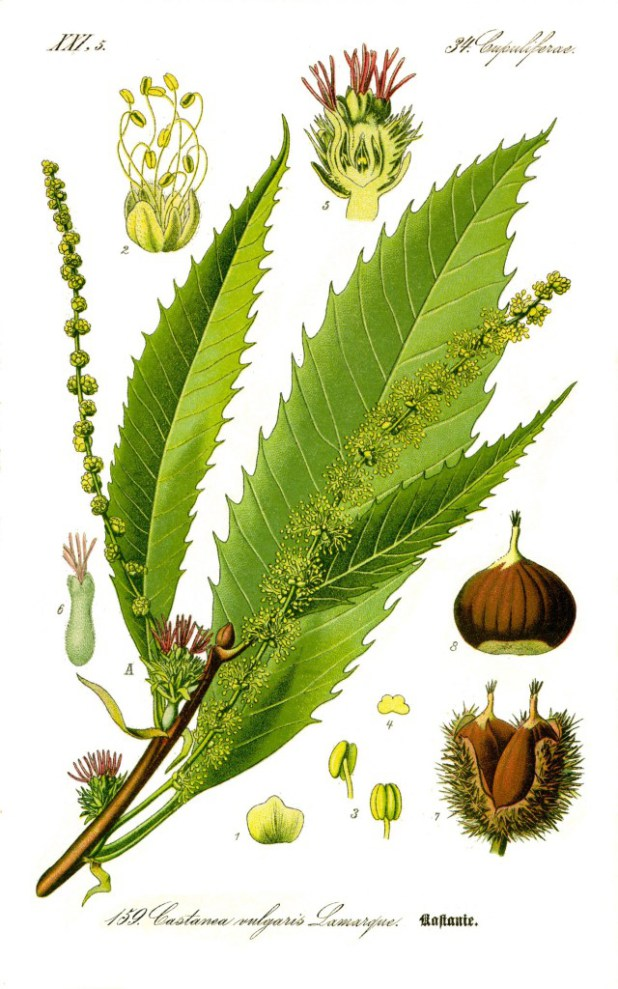
 Edible chestnut (castanea sativa)
Appearance: A stately deciduous tree that sheds its leaves for winter, almost to 30 m high. The crown is initially conical, more columnar with age, and finally, vaulted high and wide, with thick, relatively short limbs. branches. placed whorls. expand into levels of subsequent branches.
The trunk is quite thick, usually already branched at a slight height, often twisted.
The bark is initially smooth and gray-reddish, then it darkens and becomes a brownish gray, covered with a dense network of convex lamellas and deeper furrows. Stems quite strong and thick, brown or reddish brown, oval in cross section. Leaves twisted to double-row have 10-30 cm in length, they are oblong lanceolate, at the base wedge-shaped or heart-shaped, sharp at the front. The side nerves run strong, toothy, gable pointing clearly to the front. The leaf is leathery and stiff, glossy and dark green on the outside, light green on the underside.
Very numerous male pins, about 15 cm in length, light yellow.
Female flowers gathered in groups of two to five, are usually located at their base. The fruit cover is spiky on the outside, it breaks after falling, dividing into four flaps. Habitat: The edible chestnut requires a humid and mild climate, especially a light winter. It eagerly grows in medium-deep soils and rather avoids calcareous habitats, clearly preferring acid soils. Occurrence: It is found everywhere in Southern Europe, North Africa and West Asia, often in extensive stands. In areas with a mild climate, they were often planted in parks and gardens and have gone wild in places, In Central Europe, it has been at home since Roman times,
Flowering period: June to July.
General thoughts: Fruit (edible chestnuts, many), they ripen more or less from the end of September and are suitable for the preparation of a variety of very delicate dishes.
It is important when baking ripe marons, to cut the hard shell a little with a knife, otherwise the seeds may literally explode in the heat.