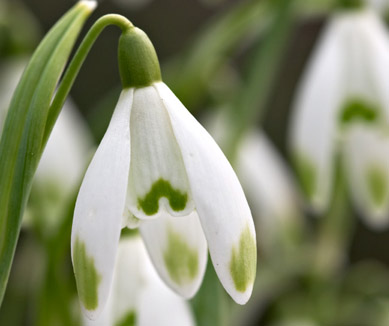
 In February and March, often still above the snow-covered ground, snowdrop flowers appear – Galanthus nivalis. It is a native species that has been cultivated in gardens since the beginning of the 16th century. Pear-shaped white flowers placed singly on stalks up to 20 cm grow from a small onion. The three outer lobes of the perianth are elongated, three internal, half the length, fused into a tube with a green spot at the top. This plant has modest requirements. Likes partial shade and light soil, humus, sufficiently moist, especially in spring. It grows in large numbers, creating characteristic clusters. Snowballs with hepes, krokusami, snowstorms, boils and early primroses are a beautiful decoration of spring beds. However, they do not like the vicinity of other strongly expanding ornamental plants. An ideal place for them on a plot or garden is the edge of ornamental shrubs. At the end of spring, once our plants have faded, shrubs get the most water, drying the ground around the bulbs, which is very beneficial for them, because snowdrops fall into a state of dormancy early. However, it is short, because from mid-summer the bulbs re-rooting and form flowers for next year's flowering. Snowdrops can grow in the same place for years. If we want our "snowdrops" to overdo it, it is best to do this after flowering, while their leaves are still visible. It is best to plant the dug out onions right away. Snowballs are under protection. We buy their onions for the garden in shops (come from reproductive plantations, they are very cheap and available from August). They have to be planted to the ground in September–October in increments of every 5-10 cm in depth 6 cm.