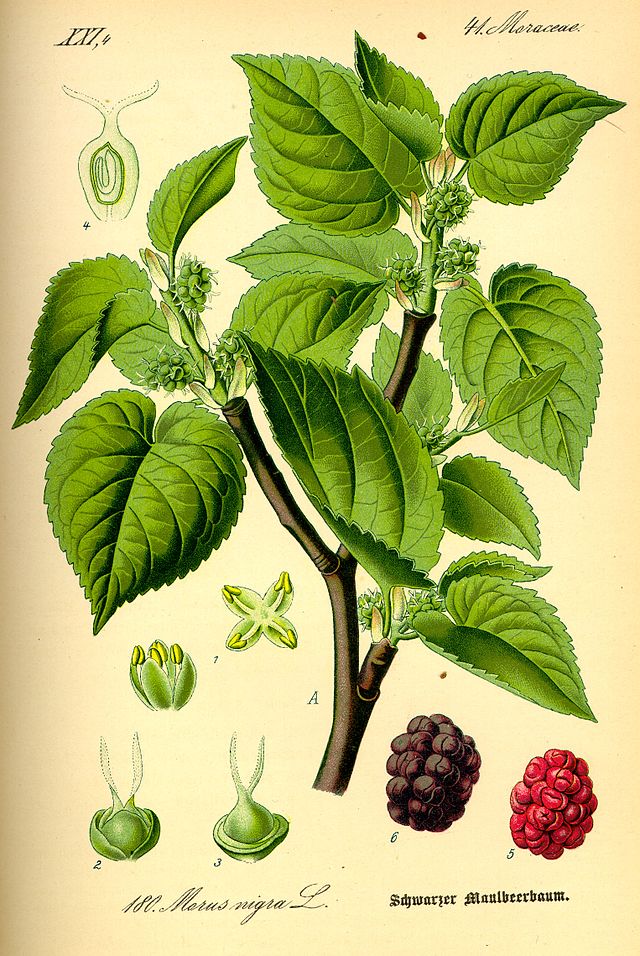
 Black mulberry (Black mulberry)
Appearance; A deciduous tree shedding its leaves for the winter, with low, often a very wide and spreading crown on a short trunk. Height usually only 8-12 m, what with a spreading crown makes, that the tree is much wider than the taller. The trunk often bent and twisted or slightly crookedly growing.
Lower branches very massive, repeatedly bent and gnarled.
Dark brown or orange-brown bark, fibrous furrowed, very uneven due to numerous nodular or tuberous thickenings of the trunk and larger branches. Shoots quite thick, light greenish, slightly hairy, with diffuse and very prominent spiracles. After cutting off, the shoots secrete milky juice. Donuts quite strong and thick, oval-conical, shiny, brown-purple.
Leaves long 7-18 cm and width about 8 cm, are broadly oval and heart-shaped, with short, slender top, at the base deeply and clearly indented, on the edge irregularly corrugatedsawed or slightly notched. Rough on top, hairy light or fresh green colours, light green on the bottom, soft and fluffy, The petiole has about 2 cm in length, is quite thick and strongly pubescent. Monoecious tree.
Male cats short, fat, lead-green. Female inflorescences even shorter. Fruit, which is a unique phenomenon, develop not from fruit-bearing fruits. only from part of the flower cover, as dark red or black-red, very tasty apparent fruits, which are edible only shortly before falling.
Flowering period: May to June. Occurrence: Black mulberry probably comes from central Asia. In India and China it has been cultivated for centuries. Wild sites are not known, therefore, the exact region of origin cannot be given. Already in antiquity, this tree was also cultivated in the Mediterranean area, especially in Italy, where today they are still found quite often. Dark red to black-purple fruits, almost to maturity, have a slightly sharp, Sour taste. They are collected and used to make cakes or jellies with a very delicate aroma,
Black mulberry also succeeds in Central Europe, but only in areas with mild winter. Before the supply of southern fruits became steadily widespread all year round. it was highly valued as a source of fruit and can even be considered a characteristic tree of old country houses, and especially – gardens by the rectory. Specimen, impressive, is located, for example, in the former parish garden on the island of Heligoland.
One of the largest known mulberry trees grows on the monastery grounds of Roscoff, Brittany. A tree over two hundred years old covers with its branches an area above 600 square meters.