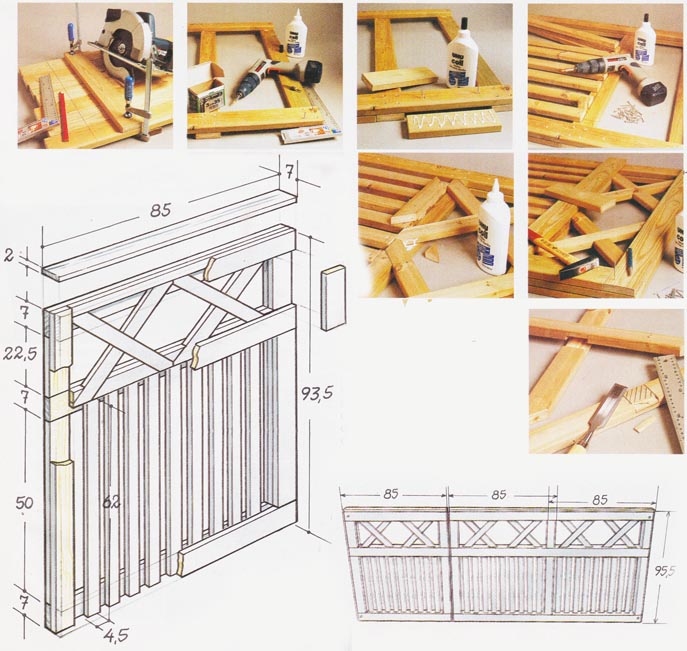
 The structure of the gate is extremely simple, because it has the form of a rectangular frame consisting of three overlapping layers of impregnated wood. Planks were used to build the gate 20 x 45 mm i 20 x 70 mm. All screws and nails should be galvanized to prevent corrosion. Waterproof white glue additionally strengthens the connections of individual elements.
The boards are serially cut. For this purpose, it is enough to fix a block made of raw wood with clamps, acting as a guide.
Two layers of boards are joined with a waterproof glue and stainless screws - at the points of contact between the elements.
Free spaces in the lower layer are filled with appropriately matched elements. The connections are made with glue and screws.
Patches and ornaments are parts of the middle layer. Free space should be measured, to make sufficiently large spacers.
Cross embellishments should be joined with an overlap at the point of their intersection. Cut both boards to be joined to half their thickness with a chisel.
The ornaments should be screwed to the boards of the lower layer, and fill the gaps between them with triangular inserts.
The third layer covers the joints of the middle layer. It should be glued and nailed. The heads must be set into the wood and riveted.
If we are building a double-leaf gate, without a separate wicket, it is worth considering the asymmetrically divided version. We present here an example of just such a non-traditional solution. All persons entering our garden now have to open only a small gate leaf with a width 85 cm, while for the car to enter the driveway, you must additionally open the second, exactly twice the size of the wing. It rests on a sliding element attached to the ground and acts as a blockade for the wicket wing. Thanks to the division into three identically decorative elements, the gate seems symmetrical. The dimensions given here refer only to this specific one, structure made by us and are indicative. Each gate should be dimensioned separately.