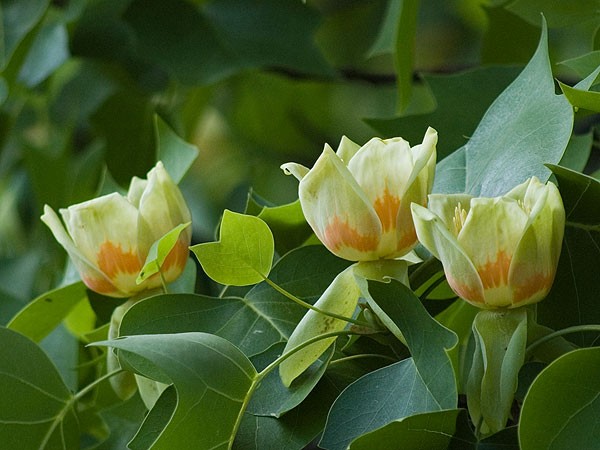
 American tulipwood (Liriodendron tulipifera)
Appearance: A tree that sheds its leaves for winter, can reach a height of more than 40 meters. In younger trees, the crown is narrow and conical, later more and more vaulted, and in the end very haughty, at the same time, however, not very wide, rather in the form of a strong column, and in a leafless state very rare, with widely spaced branches; after the development of leaves very dense and compact.
Gray bark, brownish or brown-orange, covered with a reticulated pattern of delicate, flat slats. Hairless shoots, slightly frosted, with clearly visible leaf scars, Donuts approx 1 cm in length, oval, slightly bent, slightly compressed. Leaves long 10-15 cm and width 12-20 cm, educated very specifically in a way that excludes confusion with another species: are in outline quadrangular and usually divided into four uneven-sized flaps, whose longitudinal edges run almost parallel to each other. The leaf is cut straight or slightly cut out in front – the shape resembles a tulip. Top leaf surface glossy, vivid green, and the lower – slightly brighter and as if slightly covered with wax, Young nudes, in autumn wonderfully golden-yellow, Petioles from 10 do 12 cm in length.
Flowers grow singly at the ends of twigs, when blooming initially calyx-shaped, later wider bell-shaped obtuse. The perianth is shaped in the likeness of crown Fridays. Perianth leaflets at the base bluish-green, higher yellowish orange, and at the top again greenish, inside with wide, whitish cone. Stamens thick and fleshy, May 3-5 cm in length. The ovules are focused on the central cone.
The ripe fruit resembles in appearance the cone of a pin tree.
Occurrence: The homeland of the tulipwood is the eastern and southeastern parts of North America, however, it has been around for over 300 years planted also in Europe as a park and ornamental tree; they can also be found in street plantings.
Flowering period: April to May.
General thoughts: Tulip tree doesn't quite keep up with it, what its sonorous name promises: having a flowering specimen in front of you is stated with some disappointment, that giving the name a little exaggerated. 'Lilac tree, which bears tulips’ would have to look a little more colorful. Nevertheless, tulipwood, like his other relatives in the Magnoliidae family, is very interesting botanically. Its great flowers depict a very original, not very diverse type of construction, which points to numerous references to evolutionarily older pin trees. Tulip flowers, as well as particularly large and eye-catching magnolia flowers, belong to the simplest forms of flower, which issued angiosperms,