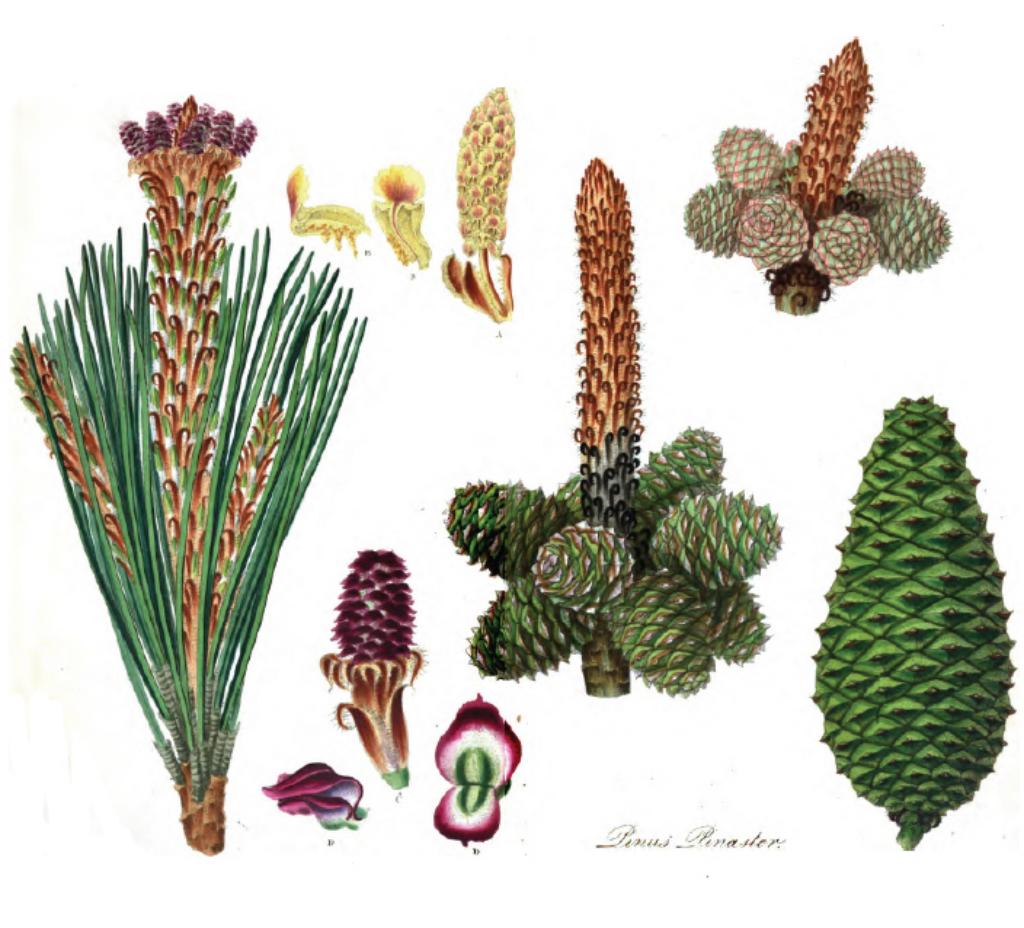
 Maritime pine (Pinus pinaster)
Appearance: An evergreen coniferous tree with a broad, predominantly flat and slightly spreading crown. The trunk is already twisted in young trees.
Main branches set very far apart, repeatedly bent and twisted, therefore the crown appears quite loose.
The bark of young specimens is still light gray, later it gets darker, black and reddish at the end of life, divided into rectangular plates by furrows. Young shoots initially greenish with darker spots, later yellowish brown and slightly striped. Shiny donuts, brown, poorly sharpened. Two pins on shoots, approx 10-25 cm and thickness less than 2,5 mm, pointed, quite hard and stiff, in a semicircular cross section, greenish gray.
Male flowers separated into younger shoots. Female cones usually collected after 2-3, initially greenish, shiny light brown when ripe, about dimensions – in a closed state- within 10-22×5-8 cm, very strong and heavy, conical-oval, at their base they usually remain slightly slanted on the tree for many years. The scales of the cones have wide rhombus-shaped discs on the outside.
Habitat: Maritime pine prefers poor, acidic sandy soils, that's why it mostly grows on dunes.
Occurrence: Important, forest-forming species of the Mediterranean area, especially widespread in its western part. It can also be found on the Portuguese and French Atlantic coasts, In southern Africa, the species is cultivated in forests over large areas.
Flowering period: April to May.
General thoughts: Maritime pine can be found relatively rarely as an ornamental tree outside its natural range. This is due to its climatic requirements: in most regions of Central Europe, this species of pine does not find suitable conditions. although its soil requirements could be met in some areas,
Due to its high resin content, wood is rarely used in carpentry, for that often – as building wood or as wood pulp for the paper industry. Apart from that, the trunks of this species of pine can be cut and harvested in large amounts of resin. It is distilled and after further processing it provides turpentine and rosin, Very large cones are also of some importance, which are often used as decorative material in gardening and bouquet making. On the big, beautiful maritime pine cones can be perfectly observed, why botanists classify conifers as gymnosperms. As soon as the rather massive scales of the cones dry, begin to part, which gives an insight into the structure of the cone. It recognizes itself immediately, that the winged seeds lie on the upper side of the cone scales in small depressions. They were also there previously as seeds. Because at this point they were not closed with additional covers, only placed slowly on the scales (i am), woody coniferous plants were included in the superior group of gymnosperms,
In my area it grows over 10 pcs of this pine ,I did not observe any frost damage when the temperature was above -20 degrees C. Already 10 the first cones have already appeared in the summer pine,information that our climate zone has the features of a myth.
where you can buy seedlings in Poland?
I grew from cones brought from the west of the tree,who already have more than 1 m. They don't mind the cold. They grow beautifully and are beautiful.
I grew such trees from cones and they tolerate frost very well. They grow very fast. It can grow approx 180 cm. Beautiful dense trees.